Shipping a vehicle from Central America to the US was like a master class in border crossings after 8 semesters of undergrad. First semester freshman year (Mexico) we were soaking it all in, eager to impress and trying to look like we were not way out of our element. By second semester (Belize) we’d gained a false sense of confidence and walked around like we owned the place. Our third semester (Guatemala) reminded us that it wasn’t all going to be easy so we needed to buckle down a bit, but that didn’t last through the end of the year (El Salvador) when we started to let down our guard again. As our junior year began (Honduras), we were told stories about people who didn’t make it and focused on our own strategy for getting through. The hard work paid off, and by the end of the second semester (Nicaragua), it was hard to get us too worked up about anything. Senior year (Costa Rica) and it was time to relax and enjoy until senioritis fully kicked in in our last semester (Panama). By then, we were just ready to get it over with and move back in with my mom, which just so happened to be our plan since we had tenants in our house until September.
Our advisor for our masters program was Julio from Panama Soluciones Logisticas recommended to us by Shaun from Panama Passage. After nothing all weekend, we heard from Julio on Monday; He’d been busy all weekend tracking down missing containers loaded with equipment for the band 311’s upcoming Central American tour. We set up an appointment in the afternoon for me to stop by and get some copies of our documents made.
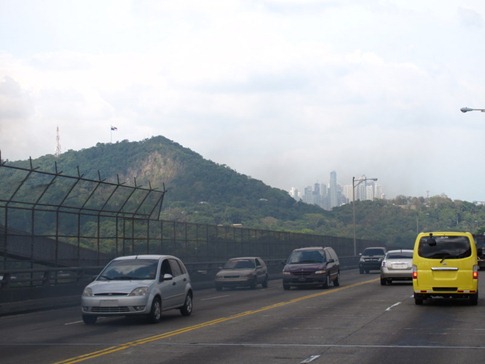
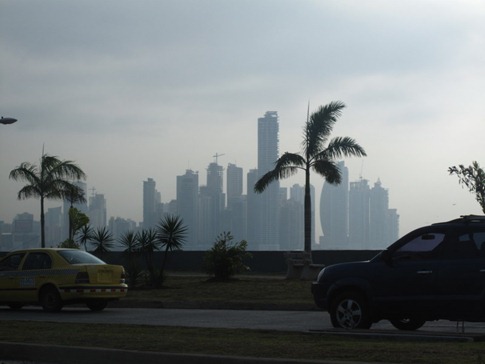
I took a taxi from Ancon to a small, two-story office building next to a hotel in the upscale El Cangrejo neighborhood. In the light of day, Panama City looked a little more approachable than it had in the zombie-infested darkness a few nights before. While there’s always something to remind you that you’re in Central America – exposed rebar coming out of the sidewalk, police with bullet-proof vests and machine guns, or bizarre feats of driving – El Cangrejo was filled with what I would later learn were called “YaYa’s,” yuppies. Julio was a lot younger than I expected, probably in his mid to late twenties - a slightly short cross between Enrique Iglesias and an Ewok (I mean that in the nicest possible way.) – but seemed to know exactly what needed to be done. Still, when I commented that Panama Passage could possibly be able to send a lot of business their way - implying that he should be extra accommodating - he explained that it was a lot easier and more profitable for him to coordinate a shipment of 50 containers loaded with toys or kitchen items than it was to hold a buncha gringos’ hands and run all over town to ship their precious vehicle (my words, not his). But even so, he was personable and went about our business cheerfully.
With the taxi window rolled down and waiting to evaluate how my proposed destination would fit into the driver’s day, I yelled “Atras del pay-tay-hota!” and he nodded for me to get in. Back in Casco Viejo the other night, I’d asked Shaun how best to tell taxi drivers where Panama Passage was. He said to tell them “Atras del pay-tay-hota.” I repeated the word a few times, “pay-tay-hota, pay-tay-hota, pay-tay-hota,” and finally admitted that I had no idea what that meant. He slowed it down; “Pe,” P. “Te,” T. “Jota,” J. The PTJ, Policia Judicial Technical. Panama Passage was behind the police station.
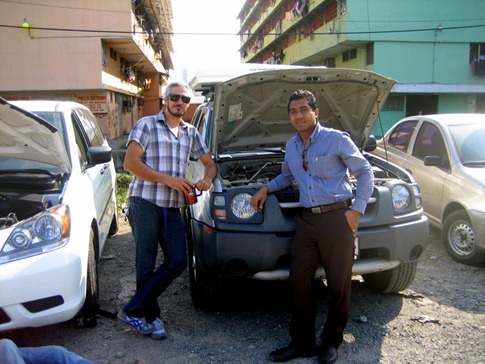
The next morning, we were on the other side of the PTJ at 8:00, waiting to have the truck inspected so a document could be created certifying that it was the vehicle listed in our title. This was the side of the PTJ that Shaun had told us not to cross over to when looking for cabs, and the ratty slum next to the parking lot certainly did look menacing. We stood around the lot, trying to find slivers of shade from a tree high above and talking to a couple importing a 2006 mini-van from the US. For them, it was cheaper to buy in the US and ship to Panama, and we started talking about what would be involved in selling our truck instead of shipping. While US models are desirable, the costs to “nationalize” the vehicle reduce how much people are willing to pay. Plus, we had a $2,500 roof tent, $800 fridge and an $800 rear tire carrier that we could sell individually back home and without the truck, we’d have to pay to ship any gear that we couldn’t carry. Just as I’d confirmed that shipping was the right move, the inspector, a guy in a tight black Nike athletic shirt and wrap around shades who’d been hanging around shootin’ the shit with the group, said we were next. A quick check of the VIN on the truck and title, and we were done.
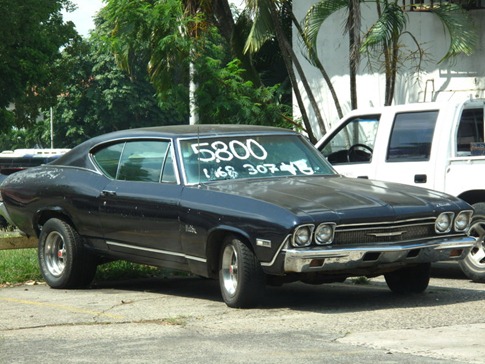
Ann’s vote was for trading the truck in on this and heading to Tierra de Fuego, but I was able to talk some sense into her.
We’d figured it might make the pre-shipping police inspections go more smoothly if the truck was empty, so we had unpacked and stacked everything into our room at Panama Passage. You know? There wasn’t much in there that we hadn’t used regularly, and we liked how reasonable the piles looked; Which is a good thing since we also knew that if we ended up having to load the truck onto a “Roll On, Roll Off” ferry where your car is not locked inside a secure container, we’d have to figure out a way to carry or ship all this stuff home to avoid it “disappearing.”
The truck felt like a sports car with everything unloaded, despite a noticeable “sag” in the suspension on one side. Ah, maybe that was the side with the fridge? Nope, other side. Probably the one with more of the weight of the rear spare tire? Actually, wrong again. We’ll have to get it checked out when we get home, but I certainly don’t think it has anything to do with it being the side Ann usually sits on. And the fact that you were thinking it makes you a bad person.
There was a minor incident while pulling out the Kolpin 4 gallon fuel pack that slides between the bars of the roof rack and under the roof top tent. I figured I needed to empty the gas out of it before shipping. You may remember that we almost ran out of gas on the way into Mazatlan a couple weeks into the trip. At that point, we hadn’t filled up the thin, rectangular fuel container and managed to put off doing it until entering Chiapas. Later, at Palenque, I’d noticed that it was bulging after being left in the sun while I got some other items out from under the roof rack. No problem, I loosened the cap to release the vapor and moved it to the shade, and it returned to its regular shape (mostly). It had been a few months in warmer temperatures and thousands of miles on hot pavement since I’d last slid the container out, and as I pulled it towards me, I could see that its edges had softened to the contours of the rounded roof rack bars. I’m not going to use the word “melted” here because there was no loss of the integrity of the container. In fact, we’d smelled gas in the car at times but always tracked it down to a loose (over over-tightened) cap on the stove fuel bottle or the lantern having been put in its box upside down. Each time, I’d also check the red Kolpin for drips but never found anything.
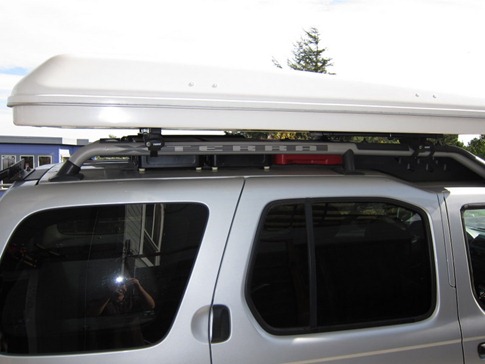
Now, the edges on either side had assumed a concave shape, hugging the rounded rack bars snuggly. Still the container slid forward on the rubber feet I’d siliconed to the bottom… until reaching the mounts for the roof tent; Here, the Thule system that supports the tent is fastened with a strap around the bars. When we’d first installed the tent, I’d looked at the rubberized straps and commented that anyone could just cut them off and steal our expensive tent. The salesman informed me that there was a steel strap embedded in the rubber. After a nominal attempt at finessing the deformed corners of the container past these straps, I switched to the brute force approach. In the past, there had always been a little resistance as I’d slid the Kolpin past these straps; Maybe it’d just take a little more “umph” this time, I thought. When the fuel started flowing down the side of the truck, I figured out that that the steel straps had lopped off one of the corners of the fuel container. Sorry, no pictures as I was afraid the click from the camera could ignite my gasoline soaked hands. Hey, if they say a cell phone can do it at a gas pump…
To complicate things, the truck was parked on a subtle side slope, leaning the ruptured corner downhill. This is one of those times you’re glad no one’s following you around with a video camera. I quickly jumped into the truck and turned it around so the hole was on the uphill side, gas sloshing everywhere as I did. Then, as smoothly as possible, I gave it one last tug to free it from between the rack bars, and with only a momentary gusher, rested it on its integral end with the hole at the top. Now, if I’d been lucky, the pour nozzle would have been also been at the top. Then, with the container tipped into pouring position, the hole would have been at the high point and may have even functioned as an extra air intake. This was not the case.
My first repair attempt was with duct tape, reasoning that it only had to hold long enough for the container to be emptied into the tank of the truck. It didn’t, and after the patch bulged like a balloon, fuel started flowing out from under the bandage. As all men know, in the rare instances when something cannot be fixed with duct tape, JB Weld is employed. JB Weld is a two part mixture that feels a lot like clay; When the two parts are mixed together, they adhere to just about anything and harden into a substance that can be sanded, milled or painted. Every guy worth his salt has a story about using JB Weld to fix a hole in an oil pan or engine block or 747 hull.
After a few hours of hardening, I confidently flipped the Kolpin over and eyed the patch. Within seconds, hair-thin geysers began erupting. Whether I hadn’t scored the patch area enough or the JB Weld had seen better days, all I wanted was to get this gas out of there and into the tank on the truck. Feeling the tickle of the gushers on the toes of my flip flops, I hurriedly screwed on the “easy pour nozzle” I’d bought from Kragen back home and flipped open the fuel door on the truck. “Effin’ locking gas cap!!!” I dug into my pocket for the keys with petroleum paws and unlocked it. As I tipped the unwieldy container upward, trying to align the short spout on the nozzle with the filler neck, fuel leaked from just about everywhere – except for the spout that is. At this exact moment, Ann came out of the house announcing that dinner was ready. I may have not been as delicate as I should have been in explaining that this was not a good time. Having thrown away my fancy nozzle which I somehow had neglected to test before leaving on the trip, Shaun finally cut a 2 liter bottle into a funnel, swapped in the cheapo nozzle from the spare can on his motorcycle, and we drained rest of the fuel into the tank; Well, what was left that had not already soaked into my skin and clothing. I couldn’t help but remember the ease with which the guy at the toll booth 30 miles short of Mazatlan had unscrewed the top of a white plastic jug, stuck a garden hose inside and siphoned off the few gallons of gas we’d needed to make it the rest of the way.
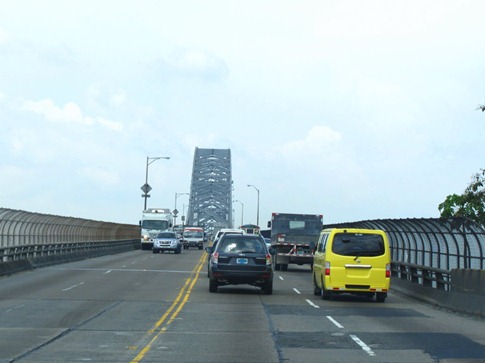
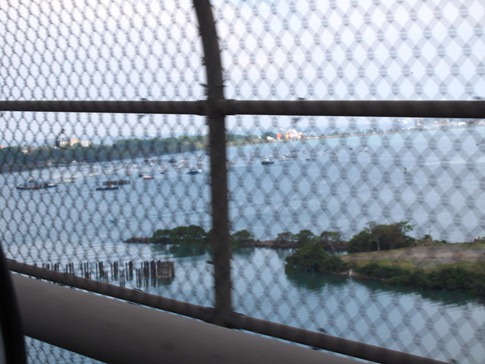
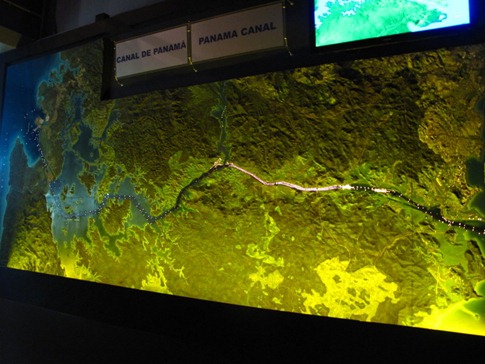
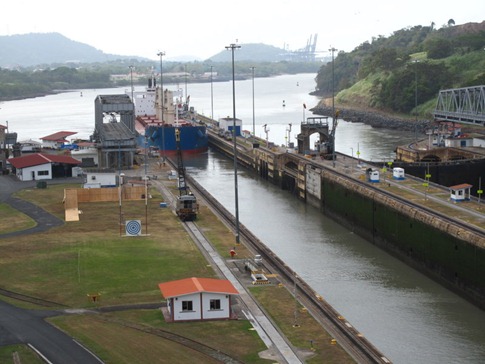
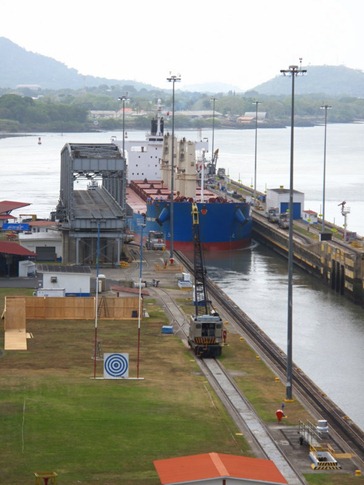
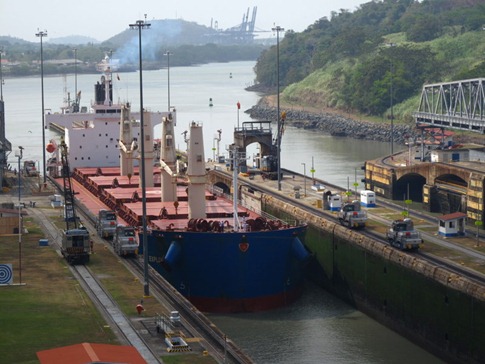
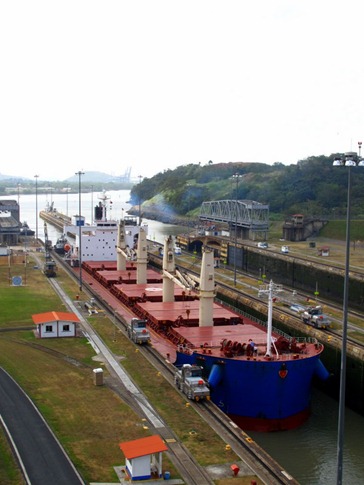
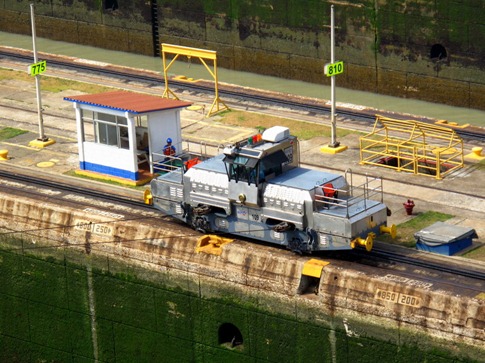
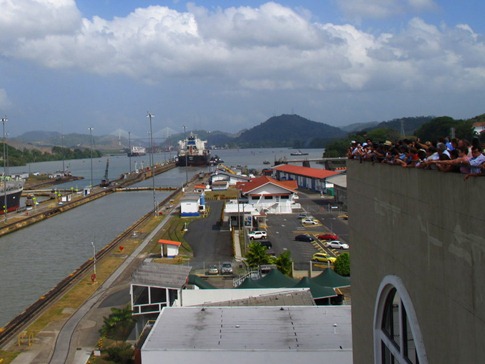
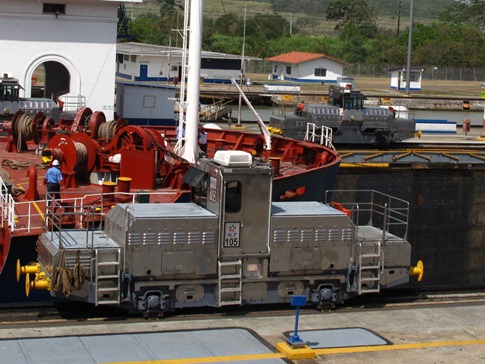
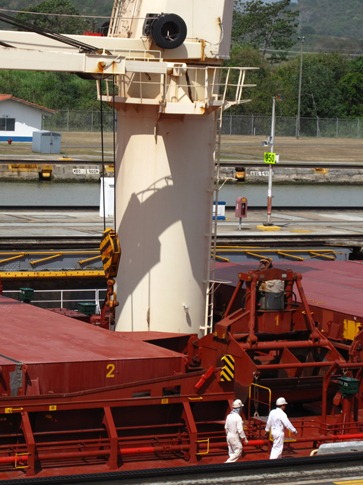
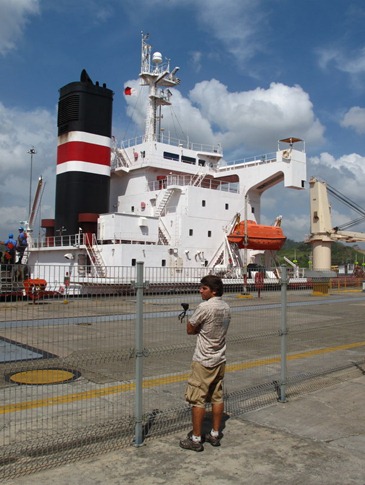
I’d met back up with Julio to return to the PTJ – there’s also a DTJ, but no one really seems to know what it stands for, and that might actually have been where we went – to pick up the completed exit document. This document is required by customs in Colon to confirm that we’re exporting the correct vehicle. Yes, customs is in Colon, on the far side of the Panama Canal. We were shocked to learn that there is no port in Panama City on the Pacific side and that our truck would actually have to go through the Panama Canal to get home!
The next morning, Shaun and I drove the truck to pick up Julio at his office at 6:30 am. On the hour and a half drive to Colon, Shaun and I bantered rapidly in the sarcastic – yes, bordering on obnoxious – rhythm that we’ve naturally fallen into. While an outside observer would say we’re pretty similar – living in San Francisco, hanging out in the Mission District, performing music or comedy in local bars, into motorcycles and adventure travel – our conversations are usually subtle jabs back and forth at the differences in our lifestyles in San Francisco, playful yet with a slight edge. I rail on him for being a hipster, weakly defending his irrational choice to ride a fixed gear bicycle in the hilliest city in the world and jabbering on about the freedom of running around naked and beglittered at Burning Man, and he ribs me because I actually live 4 minutes from the Mission in Bernal Heights, don’t mind shopping at The Gap, and take showers almost everyday. From this, the joke is that I’m “conservative.”
We also find ourselves off on tangents that we eventually realize we know very little about. One of us will say something reasonable like, “Well, I know on my KTM, the clutch is hydraulic,” but then venture way to far out on a limb with “so I can’t see how a hydraulic forklift could lift a full shipping container.” We both suffer from the male tendency to try to answer questions – “to manswer them” – without necessarily knowing what the hell we’re talking about. We briefly discussed starting a spinoff to the podcast “Stuff You Should Know” called “Stuff We Don’t Know.” It would just be us wildly speculating on things we don’t understand like whether chickens have sex or why hipsters wear those Pipi Longstocking stripped socks. Despite speaking good English, my guess is that most of the subtext of our conversation went completely over Julio’s head, and he probably just sat in the back seat trying to figure out if Shaun and I were friends or hated each other.
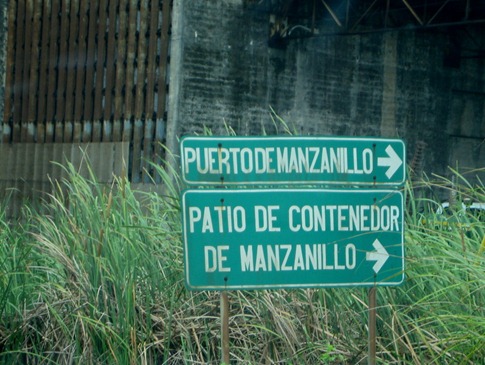
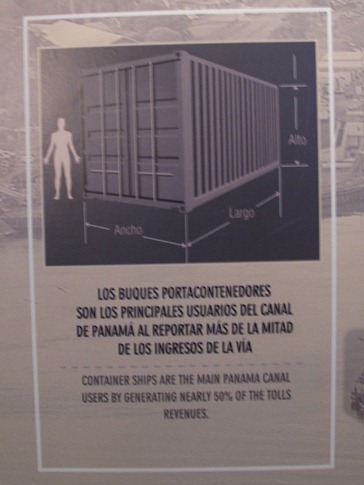
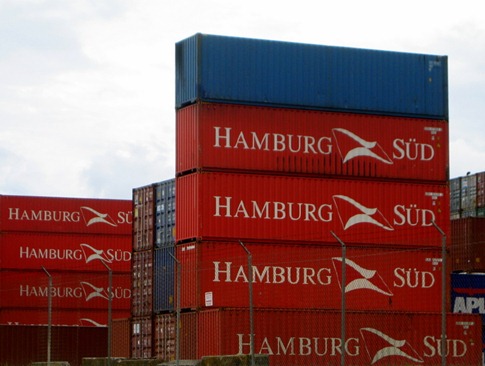
We pulled through the gate at the Puerto de Manzanillo in Colon and were forced to park in a small gated lot. On the third floor of a large office building, we found our shipper, Hamburg Sud. The woman behind a glass partition seemed to be expecting Julio, and he soon received a packet of paperwork and an orange plastic lock that would be used to seal the container. He gave the lock to me since, as I had read in other blogs, I would do the final sealing of the container with the truck inside.
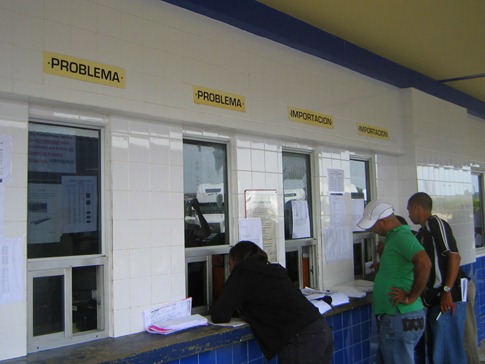
Around the corner, we found a row of windows much like those we’d seen at every border along the trip. To be honest, I have no idea what Julio did at these windows. I just paced a few behind him while Shaun haggled with guys selling pirated copies of DVD’s. I grew a little concerned when Julio went to window labeled “Problemas.” It seems that a new policy had been put into place at the port in the last couple weeks that prevented anyone from entering the port with their vehicle. I was shocked. How would I know what was put in the container? How would I know the truck was secure. It was just crazy that I would in any way be responsible for the contents of the container without being there to witness it being sealed.
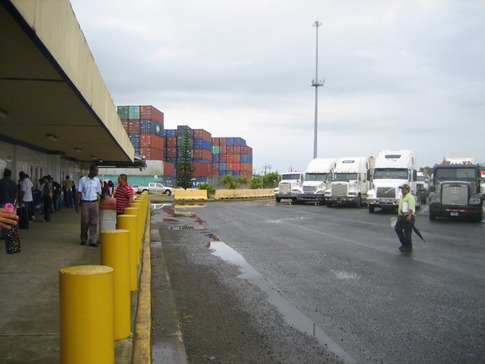
As we drove over to the free zone, warehouses filled with duty free items fresh off the boat, it started raining buckets, but we were on a mission and soon found customs. While Julio looked for a friend in the office who could keep things moving along, Shaun chatted up a cute fellow French-Canadian woman who was shipping – with her husband, unfortunately for Shaun – a Westfalia into Panama from Columbia. My passport was requested and annotations added to indicate that the truck had been officially exported. I was also given a document certifying that I was clear to exit the country without the vehicle.
A few more stops by the windows and a visit up to Hamburg Sud and we were clear to go to the port to drop off the truck. Having heard stories of 8 hour ordeals, running around for signatures and inspections, we found a row of food stalls to grab one of the better lunches I’d had on the trip: a paper bowl piled high with curried chicken and vegetables on a mound of rice.
At the port entrance, an endless line of brand new buses were being unloaded off a recently arrived ship while Julio talked to the guard about allowing me to go all the way to the container. It’s funny because one of the comments I’ve heard is about how Panama can consider itself an up-and-coming economic power when their bus system depends on 40-year-old school busses from the US air brushed with images of Jesus, tigers and large-breasted women. I guess they’re upgrading.
We put up as much of a stink as we could about needing to personally supervise the loading of the truck, but in the end, they just wouldn’t budge. There was some question about whether the new policy was for security or safety, someone at one point implying that if I had steel-toed shoes, a hard hat and an orange vest it might be possible. Shaun made a note about buying a few sets for Panama Passage.
Just inside the gate, I took about a hundred pictures of every aspect of the truck and sequestered everything I could into the locked areas behind the seat. After a canine unit sniffed it thoroughly, the official asked for my spare keys. Spare keys? Yeah, I have a spare but what are you planning on doing with mine? In the end, I gave him just the door/starter key figuring that if they lost it, I could get the spare out of the hiding place in the roof tent.

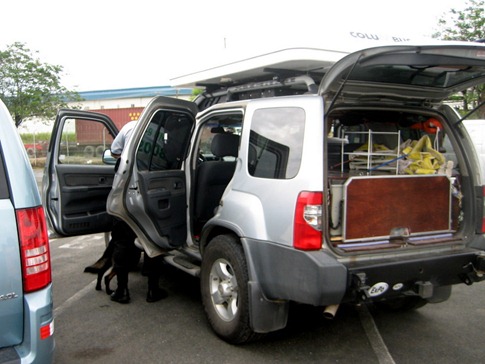
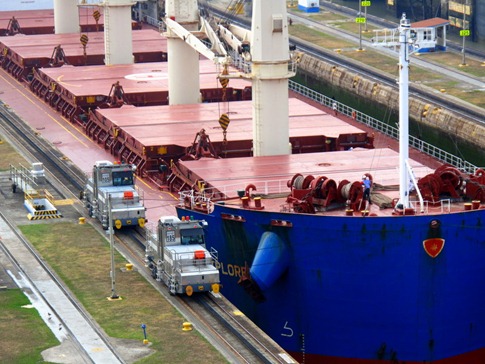
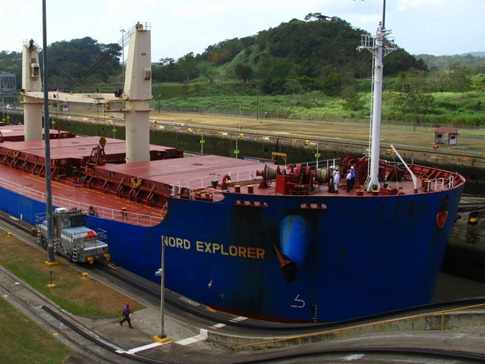
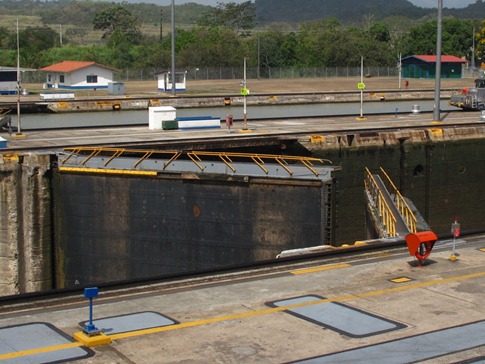
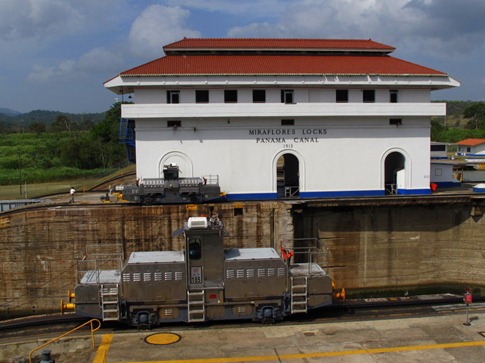
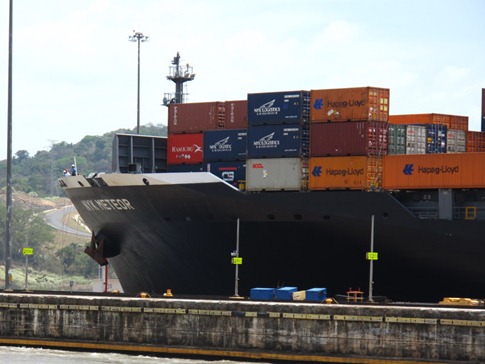
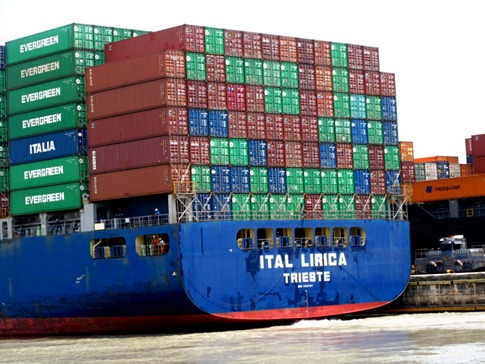
It was a strange feeling leaving that yard without the truck. There was not much choice but to trust that it would be loaded into the container and strapped down securely for the two week voyage through the Panama Canal, up along the western coast of Central America, along the Baja Peninsula and southern California and ultimately through the Golden Gate to the port of Oakland where I’d see it next.
This row of smashed up cars in the lot behind where we dropped the truck off didn’t do a lot for my confidence…

We hailed a cab outside the port and headed for the bus station for the trip back to Panama City. Since neither Ann nor I had a cell phone anymore, I had Shawn text my brother in the US and ask him to email Ann that everything went well and she should buy the tickets for the flight home ASAP; We’d been checking flights daily and finding that there was always availability and prices weren’t changing.
We sank back into our reasonably comfortable seats on the express bus. The air-conditioning dropped the wind-chill by 15 degrees, but no one was complaining after a sticky, wet day at the port. I looked down at the plastic grocery bag that now contained everything I had grabbed at the last minute from the truck: my coffee mug, the GPS, the Eagle Creek zip case with all my official documents, the bright orange seal for the container that Julio had given me earlier… wait, what? Don’t they need this to seal the container? I held it up to Julio in the seat next to me. He stood up and motioned for me to follow him off the bus. I don’t blame Shaun for not coming with us; Mission hipsters like to chart their own course ;~)
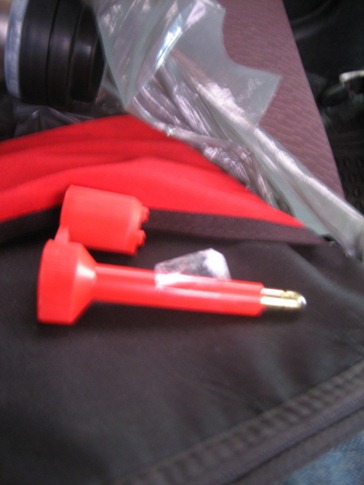
After a cab ride back to the port, a nonchalant “oh yeah” by the official, and a cab ride back to the bus station, I slept most of the way back on the bus. I got off where Julio did, figuring a $2 cab would be quicker for the rest of the ride. 20 minutes of yelling “Atras del pay-tay-hota!” through cracked taxi windows in the the pounding rain before I got a nod, and I was back at Panama Passage, 12 hours after I’d left.
That night, we received these pictures from the shipping company.
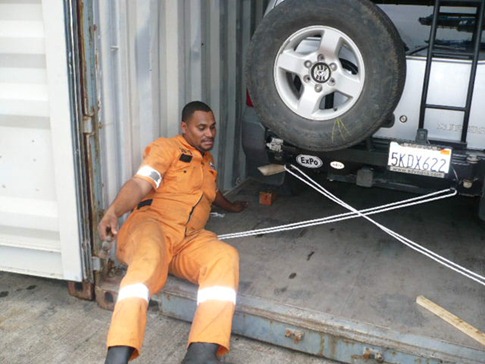
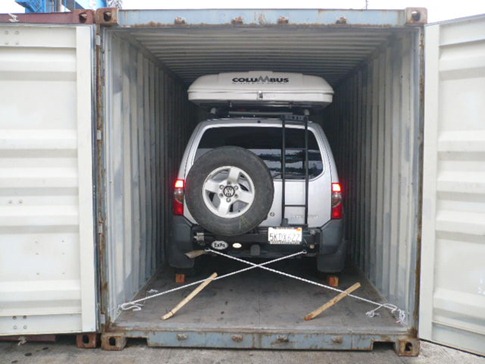
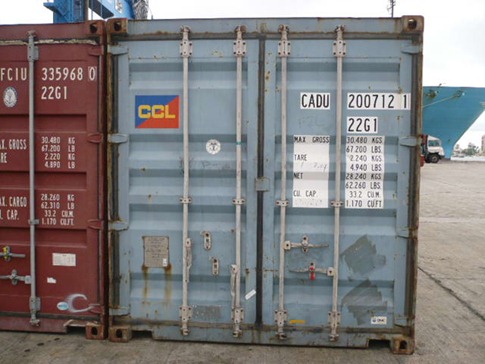

We packed the stuff we’d decided we couldn’t live without while the truck was in transit into a duffel bag we’d bought for $8.99 at the fancy enclosed mall just across the freeway. The tickets were purchased and the cab was scheduled for early the next morning. All of a sudden, we were on a plane trip, not a car trip. It felt good. Simple. Easy. With our minds full of the adventures we’d had over the past 5 months and 10,000 miles and a plan having taken shape for what we wanted our lives to look like when we got home, we fell asleep for the last night of this adventure and dreaming about the next.
Check out the video of our last days and a look back at the trip.