We left Yosemite Valley on a Thursday morning with the plan of getting up into Tuolumne Meadows early enough to grab one of the first come first served sites in the campground before the weekend. But first, one more stop at the very well stocked (though understandably expensive) grocery store in the Yosemite Village. The pic below is from the parking lot across the street. It is *not* easy to take a bad picture in Yosemite, especially with an Airstream in the foreground.

So we took a couple more on the way out!


The drive up Hwy 120 out of the Valley is steep and winding, passing through several tight tunnels, many with pull outs immediately following or preceding them, requiring some evasive maneuvers to avoid hitting the rear ends of minivans jutting out across the single white lines, but the Sequoia handled it perfectly. I snapped this shot of Half Dome in the rear view as we climbed.

At one point, we were coming around a curve and felt the trailer do a weird little jump. There was a thud too, so I limped to the next pullout, certain the next hour would involve me busting my knuckles while changing a tire. But after a walk around, I couldn’t find a thing wrong. Four perfect tires. No fender damage. A mystery, but definitely got my heart racing.
Olmsted Point, named for Frederick Law Olmsted (and his son) who co-designed many urban parks including NYC’s Central Park, looking down at Half Dome.

We arrived at the Tuolumne Meadows campground to find no problem getting a site through the weekend. Actually, the only challenge was finding one that would both fit the trailer and have enough sun for the solar. After checking available sites listed as being big enough, the ranger (a dead ringer for a young John Muir) assigned us one deep in the trees. We drove the loop a couple times and returned to the kiosk with a list of empty sites with good sun and plenty of room. Despite double-checking that none of them showed enough length in his records, he didn’t have a problem as long as we could fit. We had similar issues while booking in the Valley. Something very strange is going on with how sites are being entered into databases or understanding that trailers can be unhitched from tow vehicles.

While we were in a more open area, still only 200 ft from the Tuolumne River and spectacular view of Lembert Dome, the rest of the campground is nestled along wooded loops and tucked into little groves. This is what I remembered from my climbing days, though the big Airstream sure got a lot of jealous looks from the Patagonia poof jacket bundled climbers as the temperature at 8,600 ft started to drop.


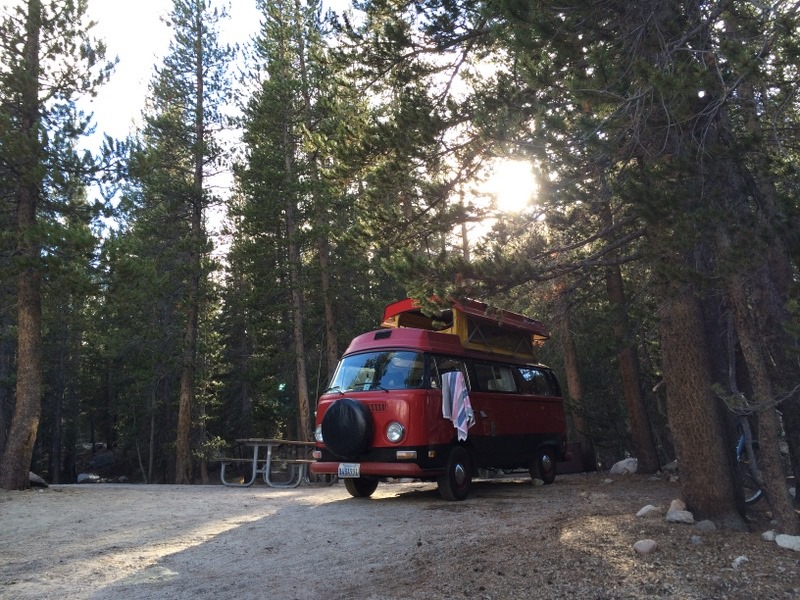
We didn’t have any big aspirations for our time in Tuolumne and, honestly, between the dog not being allowed on any trails and Ann’s back acting up (seems like this happens to all our mom friends after lugging a new baby around for a few months) too much to be comfortable carrying a pack. we basically just hung around and went for walks around the campground checking out some great smaller camping rigs.


After a couple cold nights, our batteries were starting to run a bit low, reading maybe 60% with 100 amp hours consumed on the Blue Sky remote monitor, pretty consistent with our estimated 2.5 amp hour average usage. Despite tilting the roof panels, intermittent clouds and the steep sun angle needed to hit us between the tall trees was only providing us with an hour or two of good sun each day. What really confused me, however, was the fact that our portable panel seemed to be getting plenty of sun a little farther out in the clearing of the site, maybe 5 or 6 hours a day. At that rate, it’s roughly 6 amps should have been yielding 30 amp hours each day, and our batteries should have been more like 85% or 40 amp hours down. I was scratching my head, but the plot thickened…
On Saturday morning, Dave and Kelly from Wandering with Purpose showed up and, despite being armed with my text listing several sites directly adjacent to us with lots of room and good sun, were treated to the same confusion at the kiosk and were told the only site they could fit in was right beside the entrance on a dusty road across from the dumpsters. Defeated, they set up camp. After some convincing, first of Kelly that it was worth cranking up the stabilizers and rolling off the perfectly leveled blocks to be near us and second of John Muir Jr., they moved sites and our silver camp was intact.
That meant lots of time siting in camp chairs or around a dinette talking Airstreams, travel and philosophies of life…

and Wynne joining Kelly’s morning yoga.

Although I’d admit that our view suffered a bit…

We love hanging out with these guys. While they live in their Airstream in Half Moon Bay, they (like us!) have plans to travel in it full time this coming Spring, so Dave and I had plenty to geek out about on power management, communications gadgets, organizational strategies and gray water conservation techniques (like the one seen above).
They had brought along a generator which we borrowed one afternoon, and that’s where I got even more confused about our battery situation. First, I had read somewhere in the specs for our 2000W generator that it put out 15 amps, so that’s what I expected to see when we fired theirs up. Instead, the display on our charge controller was reading something like 38 amps! Then, after running it for a couple hours, our batteries seemed to top out at about 80% and the incoming amps dropped. Puzzle piece number three was when I looked closely at the LED lights on the back of the portable panel while in full sun the next day, and it showed that it was not charging because the batteries were full.
Jump ahead a few weeks when I actually got a chance to call Magnum and Zamp to complain about their “faulty” products. Well, it turns out I know even less about electricity than I’d claimed. The 15 amps from a generator is AC not DC. Duh, 2000W divided by 120V is +/-15 amps. According to Magnum, our four stage charger takes about 9 amps AC and converts it to 50 amps DC, close to what the panel was reading. We had the bulk charge period set to 90 minutes which meant that we’d get something like 60-75 amp hours back in an hour an a half (1.5 hrs X 38-50 amps) before it switched to absorption charging.
Now, remember before when I said the batteries should have been more like 40 amp hours down if the portable panel had been working (which I had been convinced it wasn’t because of the lights on the panel)? Well, it had been; It just hadn’t been registering on the Blue Sky panel. While I knew the Blue Sky wouldn’t register incoming current from the portable panel which is wired directly to the battery, I’d assumed that it took some kind of “real-time” reading of the remaining capacity of the battery. In fact, the Blue Sky simply records amp hours it’s collected minus amp hours it’s seen used and, based on the battery capacity we told it we have, calculates a percentage.
The one real-time measure the Blue Sky does take, voltage, should have been my clue (if I had one about electricity). Voltage was reading 12.6 and above pretty much this whole time. What had that meant? It meant the batteries had been full, and yes, they were. They’d actually collected something like the anticipated 60 hours from the portable panel and instead of 100 hours down had actually been only about 40 down. Then after only the first hour of running the generator, they would have been full, though the Blue Sky would have shown them at something like 50 hours down (80%), exactly what I was seeing. At that point, all chargers – the Magnum with power coming from the generator, the Blue Sky with power coming from the roof panels, and the onboard charge controlled on the portable panel – would have detected a full battery and gone into float mode, hence the lights I was seeing on the portable. Did you follow all that? Could you explain it to me?
The lesson learned is that either everything has to be wired through the shunt where the Blue Sky records amps in/out (no direct connections to the battery), or we’re never going to have an accurate idea of the status of our batteries. Also, a lot of the worrying I had done in the Redwoods and in Yosemite about power had probably been all for nothing.
One afternoon, we walked up to the visitors center and picked up a booklet for the Junior Ranger program. Actually, under 3-6 (we had to bend the truth and say she was already three instead of two and three quarters) they’re called the Little Cubs, but this was Wynne’s (and our) first experience despite having seen the impressive collection of Junior Ranger badges from the MaliMish and Works kids.
Activities in the booklet were along the lines of mazes and puzzles but also included some basic quiz questions on things like what a bear eats or where a deer lives. Admittedly, these required a little help from mom to fill out.

But after satisfying the other requirements (taking a hike with your family or attending a ranger-led program and picking up a bag full of trash around camp), we walked back up to the visitors center for the pinning ceremony. The ranger was great and slowly fed each line of the Junior Ranger pledge, which Ann then repeated to Wynne and *swore* she heard Wynne whisper back to her, and gave her her first ever Junior Ranger wooden pin and sew-on patch.
“As a Junior Ranger, I promise to teach others about
what I learned today, explore other parks and historic
sites, and help preserve and protect these places so
future generations can enjoy them.”


Now to find a Junior Ranger vest in an XXXXXXXS.
On our last night in Tuolumne, we had Dave and Kelly over for dinner in the middle of a huge downpour. A big difference between our old 19’ Airstream and the 25’ is the ability to have other people in the trailer. I’ve said before that when you came to visit us in the 19’, you stood in the doorway, noting that all available seating and standing space already seemed to be occupied. In the 25’, you could come in and sit on the couch or we could have four people at the dinette while the kids were on the couch.
At some point during that evening, I noticed a big drip coming from the bathroom vent fan. I’ll skip ahead in time a bit to tell you that I later determined it was coming from the four screw holes that hold on the top cover. They each have a dab of sealant on them which was coming loose. Once I resealed them, the leak has been gone despite a very wet Fall/Winter in Northern California.
Our last morning, it just happened that I was wearing Mae in the Bjorn carrier when she fell asleep. This seemed like a perfect opportunity to run Ann through all the steps of getting the trailer ready to tow (she usually cleans and preps the inside while occupying the kids so I can take care of the outside).
Awnings retracted. Solar panels returned to flat.

Stabilizers up.

Truck backed into place (we’re both loving the backup camera).

Hitched up. Equalizer bars, electrical cable, safety chains, breakaway cable.
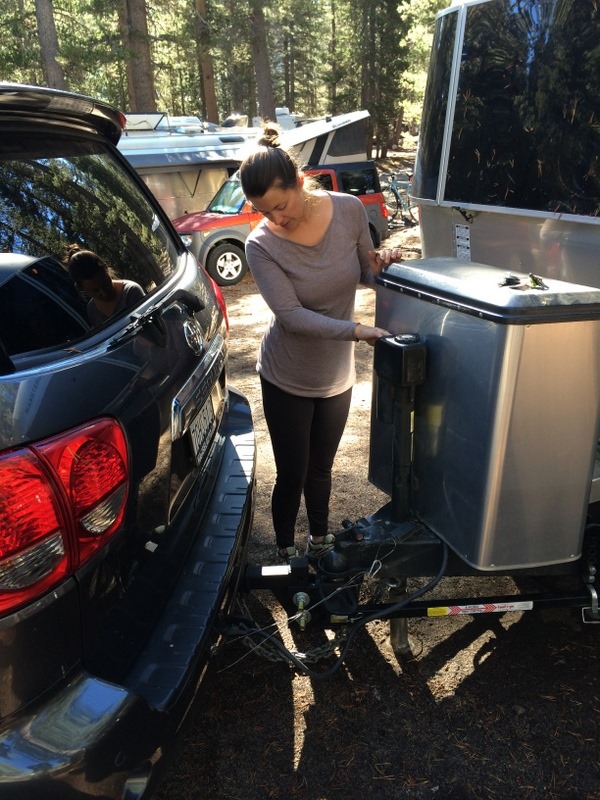
As she pulled the trailer out of the site, we realized we should probably feed Wynne and make ourselves some sandwiches for the road, so she just stopped on the opposite side of the campground road. I think after the morning she had a healthy respect for the work I do to get us rolling, so I wasn’t about to complain about the *slight* side-to-side slope of her parking spot.


Tuolumne had a very different feel to us from the hustle and bustle of Yosemite. It felt much more wild, alpine, a little bit dangerous – all of which we really liked. The campground is really awesome, feels small and has great access to impressive hikes on the granite domes. We will absolutely be back as soon as the schedule allows.