Friday, February 1, 2013

Processed Pork–Year two of raising pigs

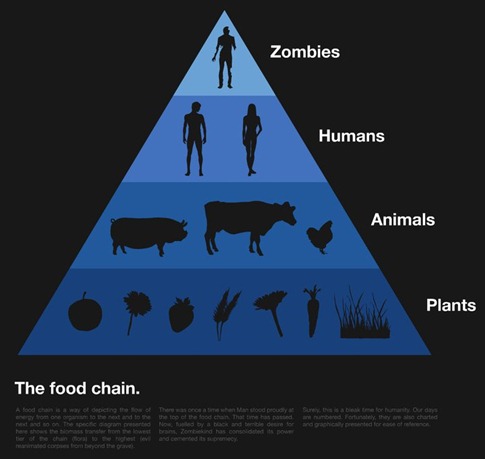
Ending an animal’s life is never an easy decision to make - it shouldn’t be – but we’d bought the four Berkshire piglets for the purpose of raising them in a healthy environment while they grew to a weight where it no longer was cost effective for us to feed them. At that point, they would become a source of meat for our family and a few friends. It’s a very interesting arrangement we’ve established with these animals, but not really much different than that between the lion and the gazelle or the bear and the salmon or the owl and the prairie mouse. There’s a food chain and we just so happen to be fairly close to the top of it.
34849_136624869702180_788812_n1

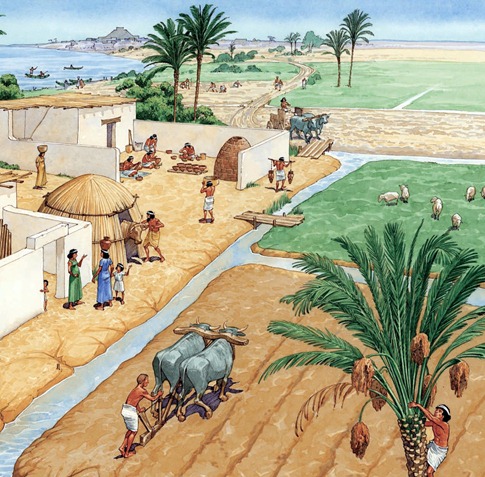
Just as other predators will migrate with prey, nomadic tribes 12,000 years ago learned that they could follow herds of animals for a predictable source of food. About 2,000 years later - whether motivated by a desire to cultivate crops or because of migrations of prey out of their area due to changing environmental conditions - they began to contain these animals in proximity to more permanent settlements. Consistent access to hides, wool and bones as well as the use of animals to provide power and fertility (manure) for agriculture allowed for concentration of populations into villages, towns and ultimately cities where surplus food could be stored and distributed. Consolidated agricultural operations and central markets shifted ex-farmers into newly-established, specialized professions like baker, shoemaker and spinster. Unfortunately, it also created the need for bankers, lawyers and soldiers. In fact, the word capital comes from a word meaning “head,” referring to cattle which comes from “chattel” or “moveable property” (as opposed to real estate). This transition, known as the Neolithic Revolution, may well have been the first roots of capitalism.
59673207-Living-in-Ancient-Mesopotamia

While it may be understandable that these animals have become a commodity – a dowry. a product that “goes to market” or something that could be traded for land - it’s only in the past 100 years or so that farming practices have adopted some of the same “efficiencies” that were developed in manufacturing plants, treating living things as mere ‘inputs” in the manufacture of a product called meat. Ancient hunters knew that their very existence relied on these animals, and they performed ceremonies to demonstrate their respect and gratitude for their sacrifice. Farmers and homesteaders have known that without the family cow or a market hog, they wouldn’t have milk, cheese, butter, meat or hides, and they took good care of their animals. But recently, populations have become increasingly detached from the source of their meat just as factory farming practices have been increasingly hidden.

To tell ya the truth, I never thought much about it before a couple years ago. I went to the grocery store, found the lowest price and bought some. Ironically, we were all raised as kids on stories and songs of the farm: Old McDonald, Mary Had a Little Lamb, The Farmer in the Dell, The Cow Jumped over the Moon. Heck, This Little Piggy Went to Market even directly references selling a pig for slaughter. And c’mon kids, didn’t it ever occur to you that chicken might come from, oh I don’t know, chickens? But we love the imagery of the farm and had come to terms with the fact that some of these animals were being raised for the dinner plate. Yes, it’s a bit of an unpleasant reality for those who choose to eat meat; A living thing has to be sacrificed to provide the meal. But as more and more information comes out about the typical conditions in a factory farm environment – whether for chickens, pigs, cattle, sheep, you name it – the old reality of knowing that a few animals that have been raised with respect and gratitude would have to “go to market” to provide for my family, seems much easier to accept than the alternative.

[END OMNIVORE’S RATIONALIZATION]
IMG_5792

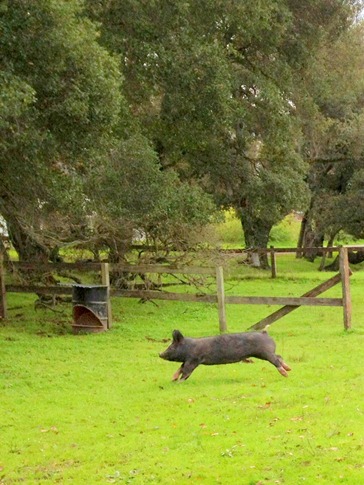
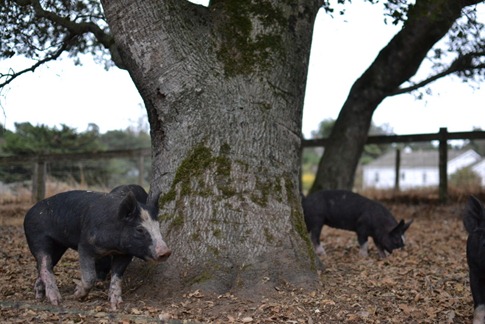
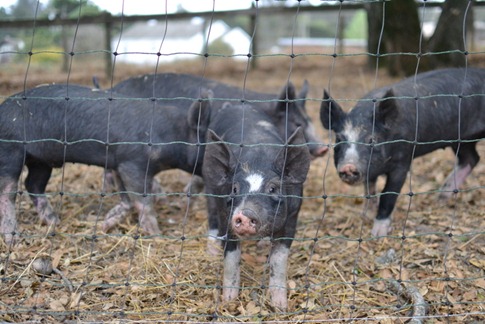
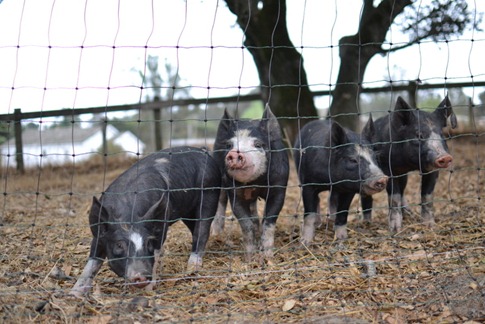
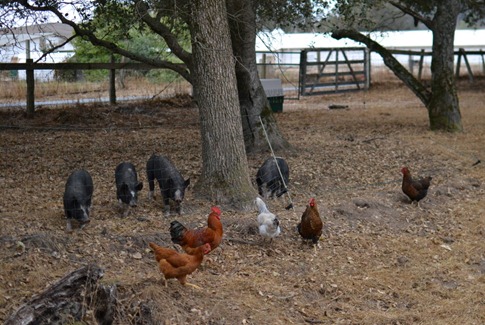
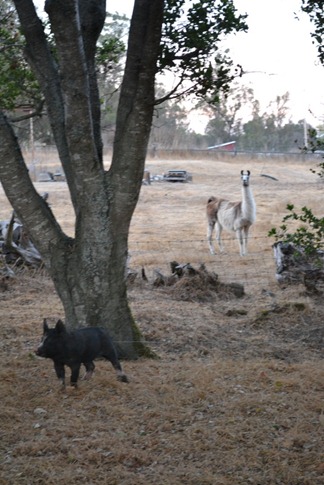
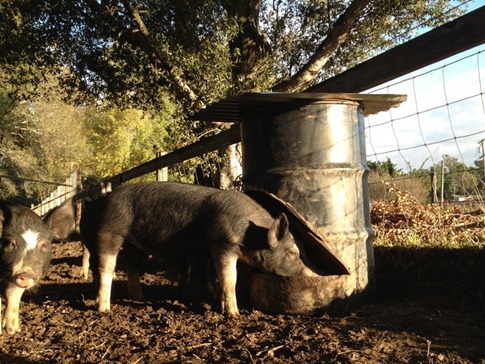
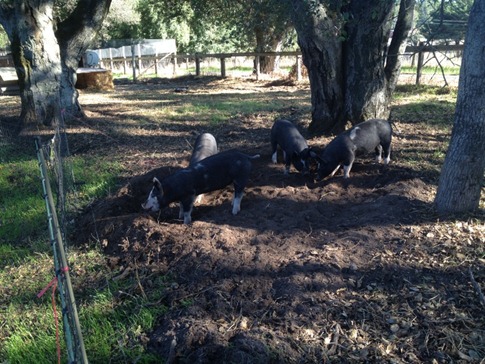
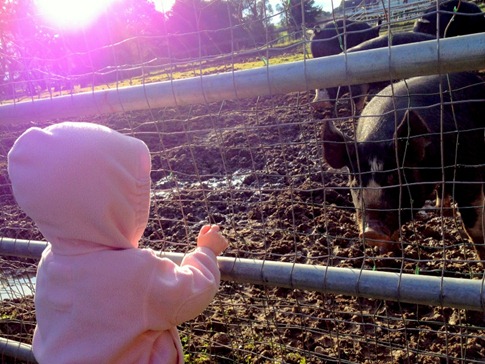
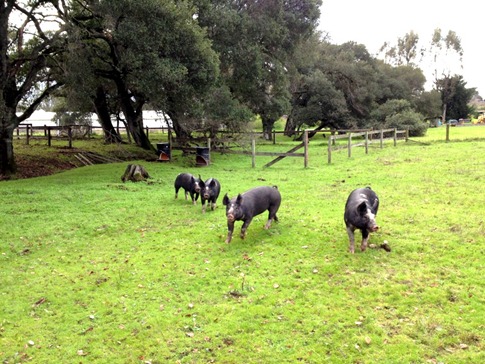
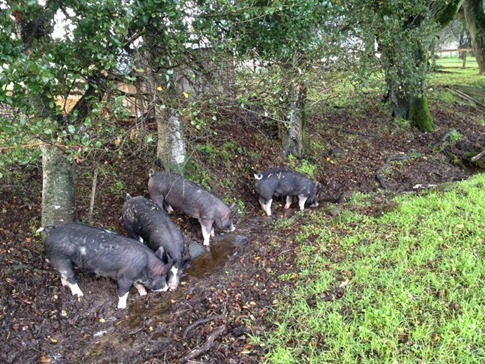
On our property, pigs live on grass, root beneath oak trees, drink from a seasonal stream and have free access to organic feed. Actually, the organic feed is the one thing I’d like to change about how they’re raised, removing the externality of transporting the grain to the feed mill from wherever it’s grown (note to self: ask where that is!), but based on what I’ve read, they can’t live on grass alone, and I’m not quite ready to plant an acre or two of corn for them to “self-harvest.” Still, the feed we use is milled and packaged less than 5 miles from us.
IMG_5519

IMG_5540

IMG_5518

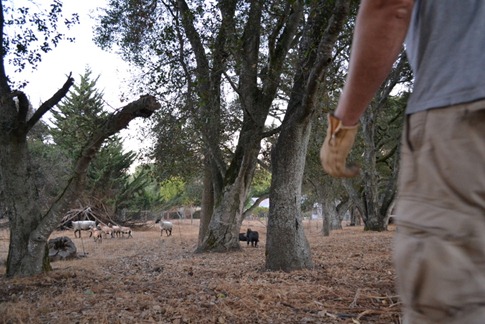
After a couple months in an 100’ x 50’ area, about 1/8 of an acre, we decided to give them even more space to run. Using a wall of one of the old chicken houses as part of the fence, we opened up almost 1/2 an acre for them. The first year we got pigs, I had been convinced by the Internet that they would be constantly trying to escape. I’d added a single strand of electric wire at snout level in addition to the electric mesh fencing and checked it all diligently. Maybe these pigs had become conditioned to the threat of the shock from the fence because, in addition to having to be coaxed out of their smaller enclosure, they never really seemed to test the far end of the fence in their new one. In fact, from time to time, I’d take that fence down and let them roam under some other oak trees on the other side that were littering the ground with acorns only to find them back in their shelter at dusk.

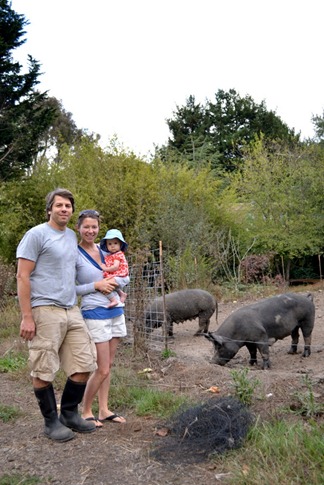
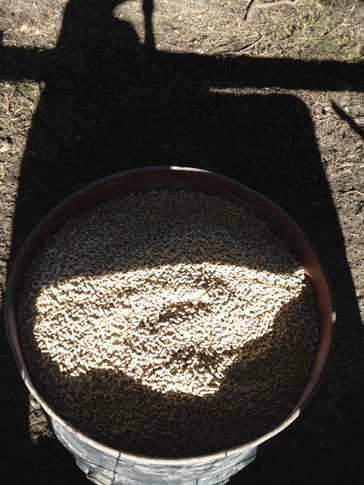
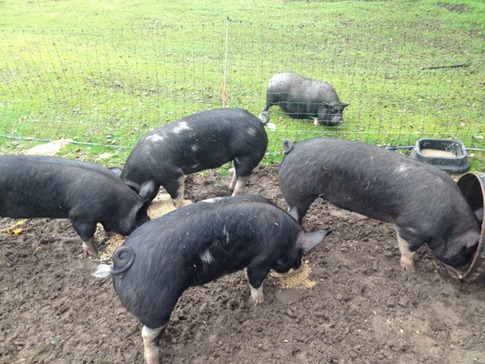
By 5 1/2 months of age, they were eating close to 10 pounds of a food a day. With the increasing price of corn and the additional expense of organic, we were paying an average of $0.45 per pound - $4.50 a day per pig and $18 for all four. Based on last year’s weights of 180 and 200 pounds, I guessed the females were 220 and the males were 240 or 250, dwarfing little 100 pound Petunia (upper in the pic). It was time to schedule the butcher. 
IMG_5937

We use what they call a “ranch butcher” who works closely with our processor. When we tell people we raise our own pigs, the first question is often “Do you butcher them yourself?” While I know we could learn the skills to do it, I don’t see any reason not to have it done by a professional with the experience and equipment to do it quickly, cleanly and without wasting any meat. I force myself to be present while they’re killed, but honestly, while last year I felt sad – at least until I realized that those two pigs meant two that wouldn’t be raised packed indoors on a concrete slab – this year my emotions went more quickly to satisfaction how they’d been treated and appreciation for the quality of meat we’d soon have in our freezer. I’ve described the process in last year’s post, so I won’t go into the gory details again, but suffice to say that within 20 minutes or so, each pig is transformed into two sides of meat hanging in the butcher’s truck.

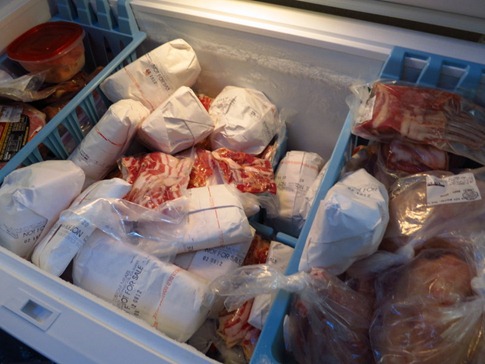
A couple days later, I got a call from the processor requesting cut instructions. With each pig divided into two sides, it’s possible to have each side made into a different variety of cuts. Having learned a lot from last year when we opted for a little of everything, this year we asked for a few of the shoulders to be used for more ground pork which we’d run out of making tacos, meatballs, pork burgers, lasagna, spaghetti sauce, etc and more of the ham sliced into 1lb packages instead of 4lb hams that took longer to defrost for a last minute picnic. Below are lists of what we got from three of the pigs. It’s interesting to note that a hanging weight of 70% of live weight is pretty typical as is a packaged weight that is 80% of hanging weight. In the end, that means you’ll end up with about 60% of the live weight of a pig by the time you get it in the freezer.

While we enjoy having the pigs around while they’re here, they’re not really the kind that you get attached to. They’re skittish and wild, the way they should be, instead of being bred for a docile willingness to live in close confinement. We’ll definitely plan to have them again next year, likely a few more given the interest from an increasing number of people to reserve a half or quarter for their families. The plan is to get some access to more local feed including plans to plant a good sized pumpkin patch for Wynne and her friends which should have plenty of extras for them. And, based on how happy they were this year, we’ll probably give them even more space to roam. Hey, it beats migrating with them.

Saturday, December 1, 2012

Wee wee wee all the way home (more pigs)

While it turns out that rumors of a global bacon shortage were largely exaggerated, we had such a good experience raising two Berkshire pigs and having them processed for the freezer last year, we decided to do it again. In fact, after a lot of inquiries from friends and family about getting some pork for themselves, this year we called our “pork pimp” – actually a homesteady family living out near the coast between Bolinas and Pt. Reyes – and asked her hold onto four for us. I’m glad I called early too, since she said someone was coming the day before us to pick up ten!

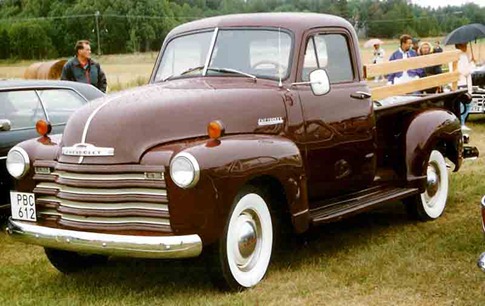
As the pick up date approached - the piglets would now be 8 weeks old and about 50 pounds - I started to look into options for getting them home. While I tried my hardest to use the opportunity to “necessitate” the purchase of this…

1952_Chevrolet_Pickup_PBC612

I mean, how good would that look with a pork-tet of prized hogs in the back?!

… I ultimately decided that a second XL dog kennel like the one we’d used to transport the piglets last year would work (for now). I closed the browser window listing 1946-1954 pickup trucks and quickly located a VariKennel for sale nearby in Santa Rosa. When I arrived at the address I’d been given, the first thing I noticed was a doormat with a pig on it. Inside were more pig themed decorations. Before I knew what I was saying, I made a comment, “I’m actually buying this kennel to go pick up some pigs.” She got very excited and told me that she loved pigs and always hoped to get one. I had a feeling she didn’t mean for the tenderloin, chops and bacon, so I quickly changed the subject.

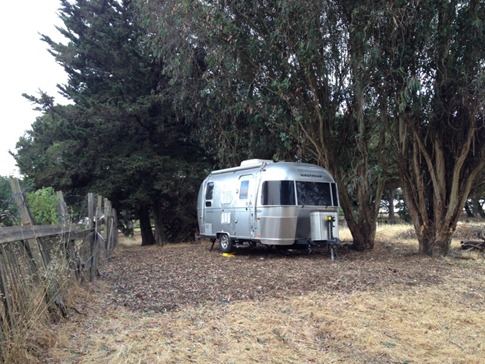
After confirming that both XL kennels would fit side by side in the cavernous cargo area of the 2006 Toyota Sequoia to which we’d recently reluctantly upsized (and down-mileaged - that’s a thing, right?) to better tow our 19’ Airstream, we arranged to pick up our porkers on a Friday morning. Last year, Karen and her husband had just started selling piglets, and it was he who had led us back to the pig paddock to wrestle them into the crates. This year, Karen pulled back the heavy hog wire panel and stepped into the galvanized hoop shelter to persuade our piglets into the carriers. While I bravely held the kennels steady, she bobbed, weaved and head-faked until she could grab each one by the hind legs and walk them wheelbarrow-style to the door.

Thanks to our friend Nina Brandin who came along for the ride for many of the pics!

DSC_2792

DSC_2772

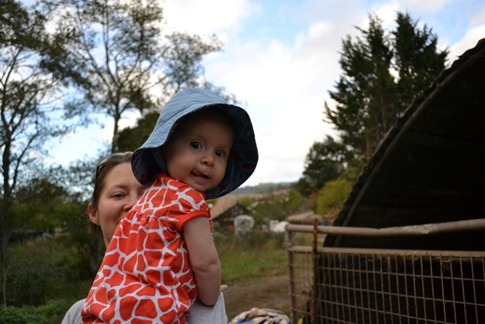
Wynne, of course, supervised the whole operation.

DSC_2803

The breeding pair. I’m talking about the pigs here, people…

DSC_2815

With four piglets loaded up, we shut the rear hatch and strapped the baby into her car seat. Only then did we remember the smell of pig shit in an enclosed vehicle. We drove the 35 minutes home with the windows open.

DSC_2824

The week before, I’d started the process of preparing the pig enclosure. Last year, we’d arranged one of our 164’ wire mesh electric fences (with an additional single strand hot wire about snout height) in a square along one side of our property. After a couple months, the two pigs had rooted just about every inch, and we moved the entire enclosure just up the fence line to give them some fresh ground. This year, we not only wanted them to have some more room but to give that land a rest from the abuse and decided to set up the pig enclosure even farther up the fence.

As I was unrolling the last 10 feet or so of the electric mesh in the upper area, I noticed a few buzzing insects flying in and out of a hole at the base of a tree. Now, Ann and I have been talking a lot about setting up a bee hive for the honey and the pollination benefits so I knew very well that these humble workers would not sting me unless they felt threatened. I cut a wide path around their home and completed my fence run. I took an even wider detour on the way back, walking about 15 feet away from the entrance and over a small pile of brush I’d put aside after some clearing that summer.

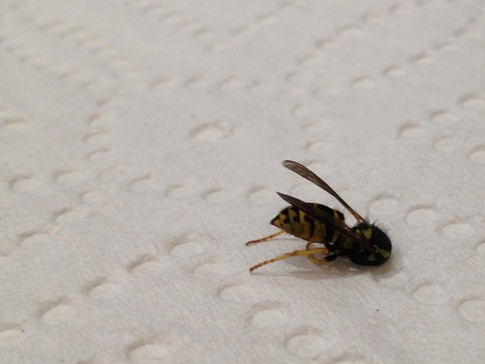
When I felt the first sting on my elbow, I looked over towards the entrance at the base of the tree I’d carefully avoided and thought “Hey, what the hell? I thought we were cool!” I felt the second sting on my upper arm and began to realize my first critical miscalculation; These were not docile bees but rather aggressive yellow jackets, fiercely protective of their nest. I wouldn’t realize my second error for several days; More on that to come. The urge to run was uncontrollable though I quickly came to understand the irony of the fact that I had just completed fencing myself in. With my lead Muck boot pointed towards open ground and my other tucked close in under the seat of my Carhartts, I hurdled the fence with surprising agility. Now maybe 50 feet from the nest, I felt the third sting, this time on my head. I started picturing every bee sting sequence in every movie I’d ever seen with some poor schmuck running madly through the woods flailing his arms wildly. Why in the hell didn’t we have a pond I could jump into (possibly breathing underwater through a reed I’d plucked from the bank)?! I made it the 200 feet to the pump house and the nearest hose in record time and started spraying my head with the nozzle and combing my fingers through my hair. Stings four and five were on my hand and number six on my head before the excitement subsided.

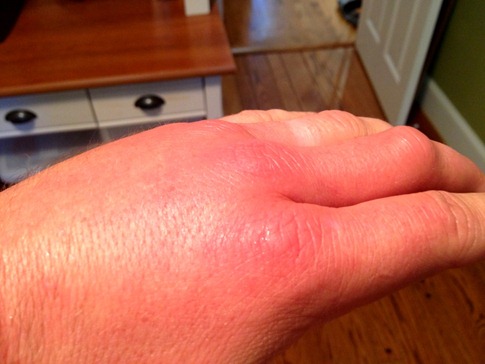
I came inside through the mudroom, slipped off my boots and walked into the living room where I found Ann sitting on the couch with Wynne. She knew enough to suspect that there was a story behind my wet, tussled hair, shortness of breath and wide eyes, and when I told it, had the same thought I was having; The last time I’d been stung multiple times was by fire ants in a campground outside of Palenque in Chiapas, Mexico, and I’d quickly developed hives all over my body. After a Benadryl, I took a cool shower - reminiscent of my dips in the mineral waters of Agua Azul and the jungle pool at the Mexican campground - to slow the reaction. With one final yellow jacket washed out of my hair and circling the shower drain, I sat down to wait. While the hives did develop to some extent, the worst was the swelling in my hand which started inflating like a balloon.

IMG_4682

IMG_4680

After an extensive web search, my plan for revenge took shape. No, I didn’t follow the advice of those suggesting I pour a gallon of gasoline down the nest entrance although, to their credit, almost half of the respondents did not recommend throwing a match in after it. Instead, I’d launch an attack in the cold dark of sunrise, when the nest would be inactive, armed with can of RAID foaming poison boasting a spray range of 29 feet. Oh, and at the insistence of my wife and mother, with protective gear and an EpiPen. 

IMG_4701

After sequential early morning raids (pun intended), I wandered out one afternoon to examine the results of my scorched earth campaign and to finish setting up the fence for the pigs. The entrance was still. No sign of any of the nasty little buggers coming in or out. But for some reason, I had an eerie feeling. I walked out of the fenced enclosure the way I’d come in, went out the side gate of the property and walked around the far side of the brush pile where I’d been stung. At first, I didn’t see anything, but then the first one came into focus. And the second. Then tens of them flying in and out of a hole tucked deep into the tangle of twigs. My second error on the day I’d been stung was that, while thinking I was giving the nest a wide birth, I’d actually been trampling directly on top of another entrance. Fortunately, I’d narrowly avoided making a third mistake – well, technically my second one all over – by tromping right back over the nest. Eh, on second thought, I think that land where we had the pigs last year has probably recovered enough to put them down there again. Using the non-electrified side fence in addition to the electric mesh, I was able to double their area to over 100’ long and 50’ wide.

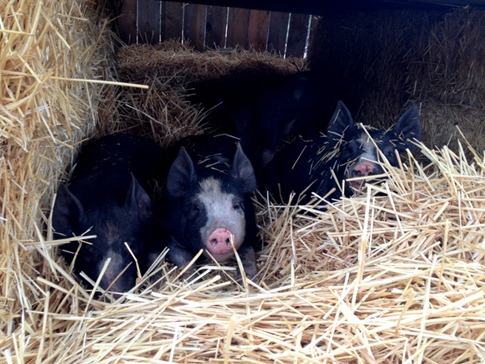
After the long, curvy drive home, you’d think the first thing these little piglets would want to do is get out of the kennels, but I had to lift the ends to practically pour them out the open doors onto the pasture. Once they regained their footing, they quickly went about exploring their new surroundings.

DSC_2867

DSC_2881

DSC_3071

DSC_3052

DSC_3058

Of course, everyone else had to come over to see the new arrivals while the protector, Michelle Ob’llama kept a watchful eye.

DSC_3078

DSC_2870

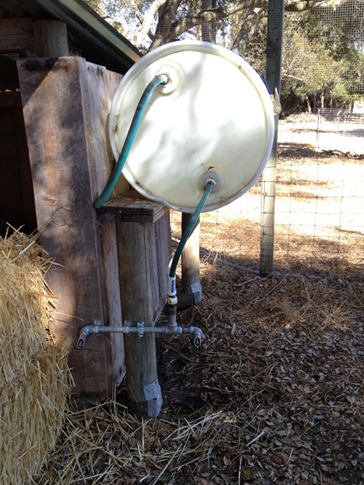
Last year, I’d built a 4’ x 8’ shed with a galvanized roof out of planting boxes reclaimed from a local mushroom farm and rigged a 55 gallon plastic barrel with some gravity fed water nipples that the pigs could activate with their tongues. The problem was that I had to refill the barrel periodically leading to some adventures with a dangerously overloaded ATV. My goal this year was to minimize or eliminate daily chores out at the pig paddock, so with careful positioning of the water barrel and the purchase of one more long hose, I was able to set up a garden timer to automatically top off the barrel every few days from a spigot by the greenhouse. With a little adjustment, I was able to figure out how often and how long the timer needed to run to keep up with their thirst. Of course, I couldn’t have anticipated that the mischievous little guys would unscrew one of the nipples letting all the water out and creating a great mud puddle for rolling around. Locktite has prevented a repeat.

IMG_4752

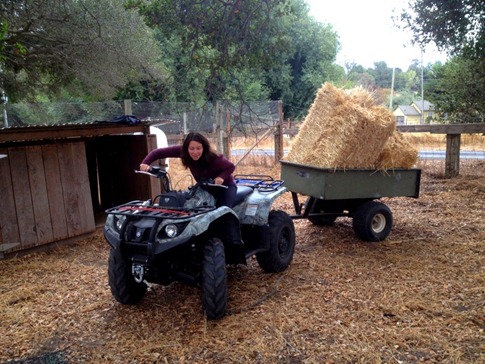
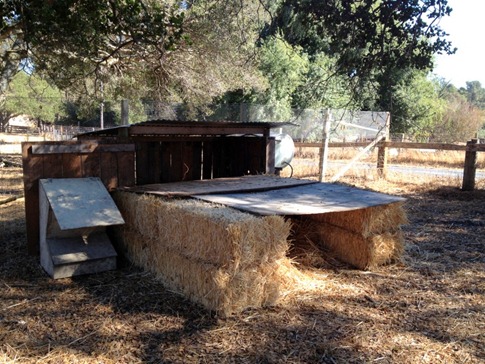
A neighbor offered some extra bales of straw that made for a nice little annex on the shelter. Which gave Ann a chance to show off her skills at backing the ATV with the trailer anyway…

IMG_4709

IMG_4750

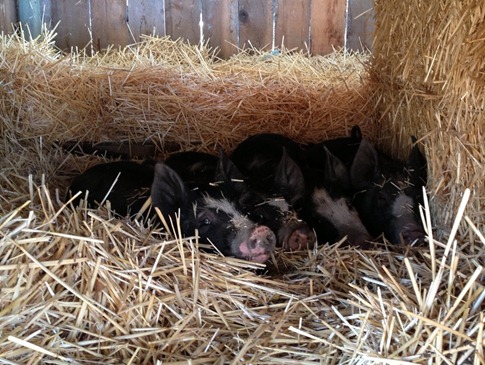
And the four little pigs seemed to think straw was a perfectly acceptable building material for their house (though full disclaimer: we don’t get a lotta hyperventilating wolves in these parts).

IMG_4823

IMG_4795

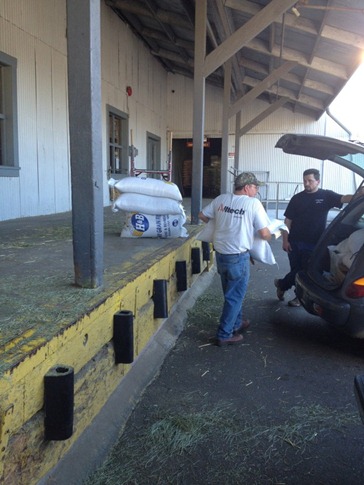
Refilling food had also been a regular chore last year, growing more frequent as the pigs went from eating about 2 pounds of food a day at 50 pounds to 7 pounds a day at 200. In addition to what they can get from the pasture, we’ve been offering them “free-choice” – as much as they want when they want it – organic pig feed. I’ll usually go down to the feed store and load up on eight bags. Unfortunately, there’s no volume discount until you basically have a silo at home.

IMG_5136

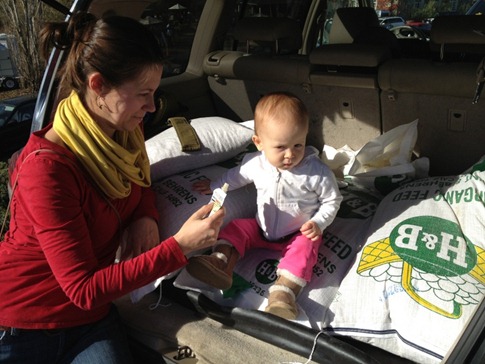
We’ve found that having a few bags in the back of the car can make for a nice lounge for an on-the-go lunch.

IMG_5449

[INSERT JOKE HERE ABOUT FEEDING YOUR PIGS ON PASTURE AND YOUR KIDS ON FEED]

IMG_5437

Last year, I built a gravity feeder out of some 1/2” plywood that worked great. That is, until the pigs would deplete the 100 pounds of food it held and knock it over to get at the last crumbs, pretty much destroying it in the process. The farm supply stores sell more durable commercial feeders, but I thought I could probably build something just as good. Google searches lead me to this video and the concept of using a 55 gallon barrel with holes drilled on the sides that would let feed fall out when the pigs rolled it around.

Pretty cool, but in our case, the pigs would just push it against one of the electric fences and either knock the fence over or not be able to roll it away without getting buzzed. Instead, I came up with another idea to make barrel into a gravity feeder like the one I’d built before only with more capacity and much more durable.

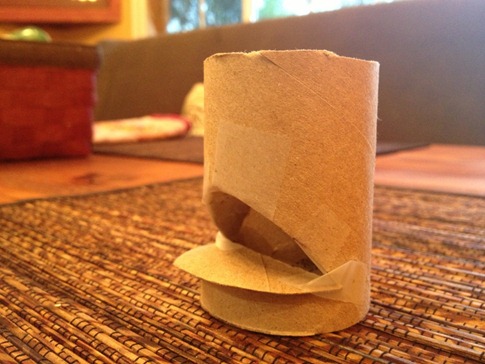
While prototyping with a toilet paper roll, I realized that a wedge cut out of the side of the barrel could be fit back inside as a ledge that would channel feed towards the back.

IMG_5098

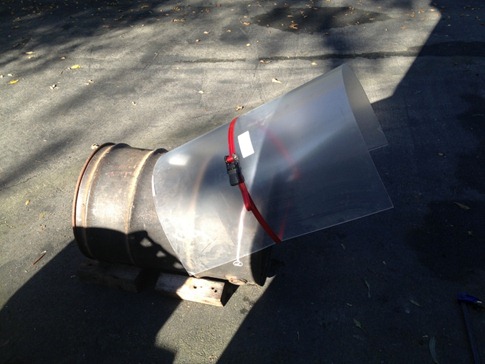
A rolled piece of rigid plastic served as the template to make the cut that would mimic a cylinder intersecting another cylinder. I’m sorry, Mrs. Schiller, for ever doubting your claim that geometry would be useful to me in my later life!

IMG_5425

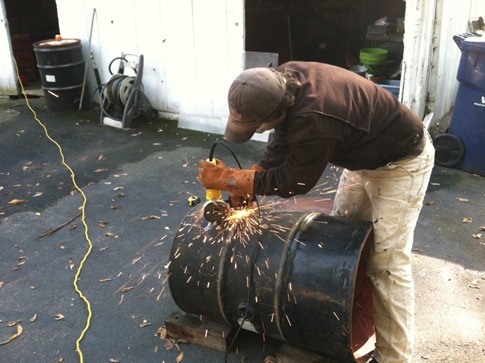
A cut off disc on an angle grinder took care of the cut (and qualified me for baddassery badge for the day).

IMG_0743

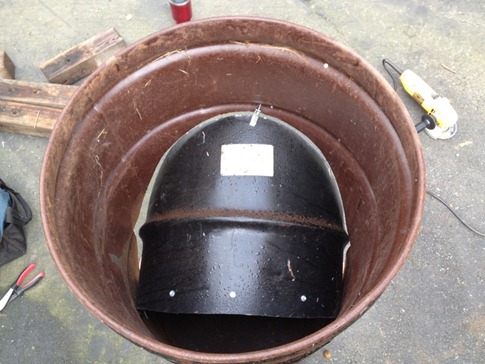
With the wedge flipped and fit into place, an angle bracket at the top and some screws at the corners secured it in place. My first approach filled any gaps with Bondo but I later went with an expanding foam.

IMG_5458

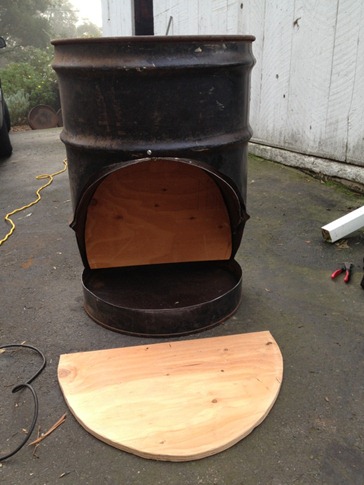
A vertical piece of plywood formed the back of the “chute” the dropped the food into the lower bin and a horizontal one was hinged as a cover the pigs could flip up with their snouts.

IMG_5459

Topped off with 200 pounds of food…

IMG_5413

… the pigs knew exactly what to do!

IMG_5402

When not eating from the feeders, these guys have been having fun rooting the soil with their incredibly powerful snouts. Before long, this entire area will have been turned over to fresh soil, a valuable process for the land.

IMG_5133

And of course, they get the occasional treat from the garden…

IMG_5028

IMG_4826

Or front porch.

IMG_2433

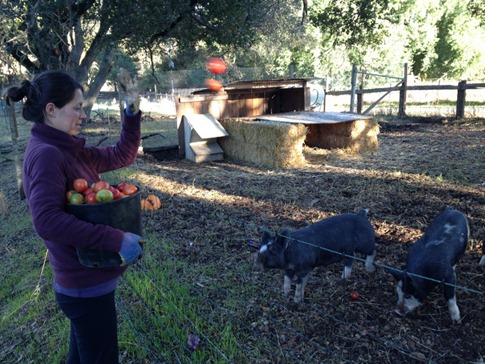
After 5 months or so of the good life, the pigs will be up around 200-220 pounds. Honestly, they start getting a little scary at that size, snorting and sprinting excitedly around their area when they see one of us approach with a bucket of kitchen scraps. And you can bet more than one friend forwarded me the news article about the Oregon man eaten by his pigs.

For now, we’re enjoying having them around and feel good about the life they’d lead before becoming a year-long supply of meat for our family and a few friends that we can personally take responsibility for.

Saturday, September 1, 2012

End of the summer (or the WORLD?!)

We never made a big bold statement about wanting to produce 100% of our food for ourselves on our land, but the closer we get, the more tempting that goal becomes. Self sufficiency means not only having enough food in the event of a disaster but also not having to worry about the source, production methods and inputs of food bought elsewhere. From grass-fed, pasture-raised, humanely-slaughtered meat to fruits and vegetables without pesticides, genetic modification or passports with more stamps than well… Us!… it can be more exhausting reading labels and/or feeling guilty than just getting outside and planting a few more things in the garden. So, whether we’re preparing for the end of summer or TEOTWAWKI (say “tea-ought-wah-key,” The End of the World As We Know It), we’ve been doing a lot of preserving and some thinking about what services and resources we’re dependent upon.

IMG_4209

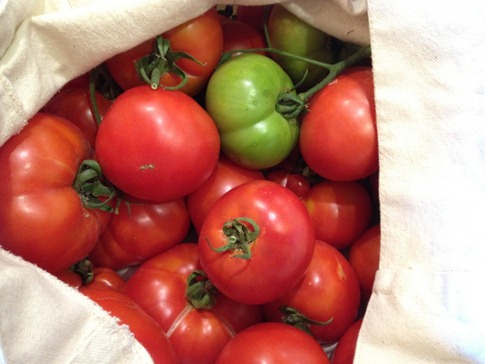
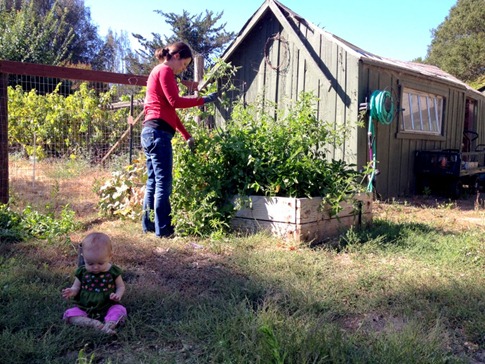
Planning a garden to provide year-round produce is a tough proposition, but we’re getting better. In addition to adding brussel sprouts and spinach to the broccoli and kale we planted in last year’s Fall garden, we’ve been canning this year’s bounty of tomatoes as they ripen on the vine. Now, it should be mentioned that I hate tomatoes. Well, raw tomatoes. While most backyard gardeners speak in hushed tones of biting into a fresh-picked tomato or popping the cherry variety into their mouths like Skittles, the thought makes me gag. It’s a shame really; I love the aesthetic of the bulbous, striped heirloom varieties and the ease of sitting back while a small, spindly starter plant expands to overwhelm any possible wire cage in which one might try to contain it. I’ve even come to like the sweet smell of the plants, but each time I’m tempted to try one of the bright red fruits, they just don’t do it for me. Fortunately, with a little help in the kitchen, these repulsive, squishy, seedy orbs can actually be turned into something delicious. Yes, it’s true!

IMG_4026

IMG_4377

From our 4 Roma plants and 2 Beefsteaks, we’ve thus far diced and canned something like 15 quart-size jars worth, layered in with fresh basil. We use a standard water bath canning process with some lemon juice added to increase acidity and prevent bacterial growth.

IMG_4030

And store them in a broken old chest freezer we got off Craigslist where they stay cool and dark. 

IMG_4485

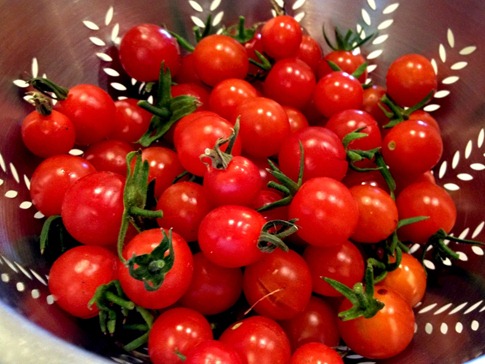
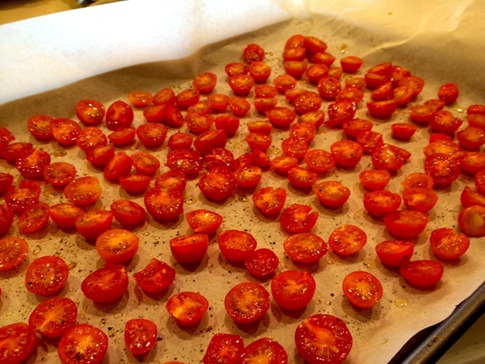
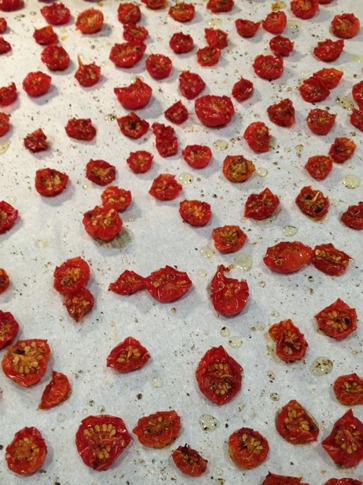
And from the two cherry tomatoes plants, we’ve been drying them halved with a sprinkle of olive oil and salt and pepper on some parchment in the oven (5+ hours at 170 until the consistency of raisins). The instructions we followed claimed they’d stay good in the fridge for 6 months!

IMG_4211

IMG_4212 IMG_4217

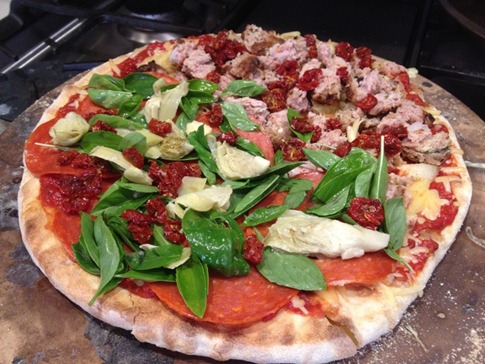
Great on homemade pizza. Yep, the dough recipe is from my lazy baking bible, Artisan Bread in Five Minutes a Day. One batch of dough makes about two large pizzas, though we typically wrap half in plastic and put it in the freezer to be defrosted on the next pizza night. The basil’s from the garden but the pepperoni, pork sausage and artichoke hearts were “outsourced.” Don’t worry, our artichokes should be ready this Spring and you can read about “pork plans” later in this post, so this combo should be available at the TEOTWAWKI party even if civilization is crumbling and societal fabric has been torn shreds.

IMG_4241

Note that we pre-baked the crust on the above pie for about 5 mins before loading it up with toppings. Here it’s on our well-used pizza stone ready to go back in for 15 minutes at 550.

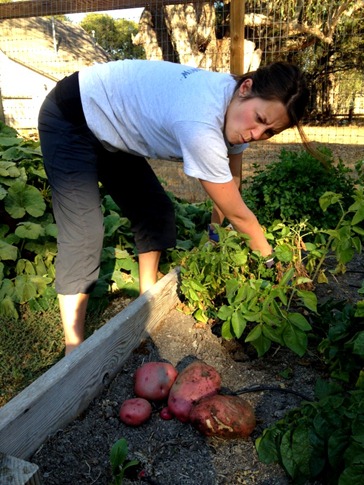
I think these potatoes may have gotten a little overbaked. Huge!

IMG_4559

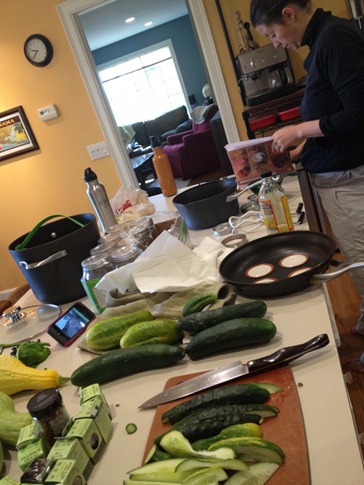
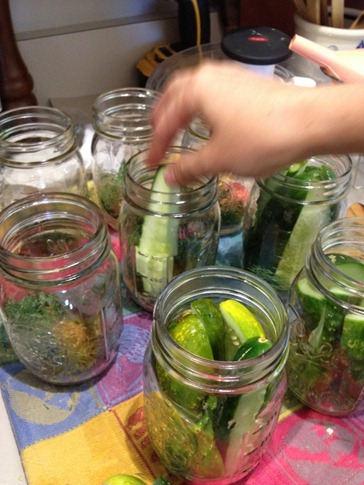
Okay, pickles aren’t much of a survival food but they’re delicious. Actually, if we’re being honest, this particular batch was terrible. Ann went with a complex cocktail of expensive and exotic spices that came from Whole Foods in tiny plastic bags, but something was way too strong. Later batches were a more simple dill recipe. Next year, we’ll try to pick our pickles (called a “peck” or is that peppers?) when they’re a little smaller so they can be canned whole to stay a little crunchier. We also wanna try this recipe for pickling a variety of miniature squash.

IMG_3918

IMG_3924

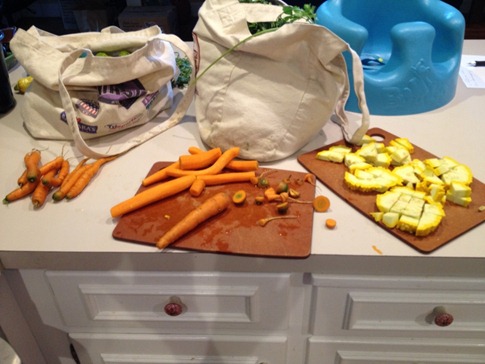
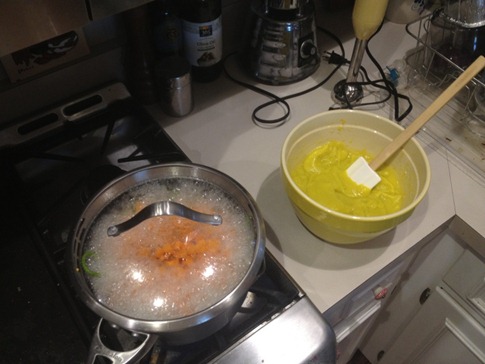
In the rest of the garden, we’re just trying to figure out how to preserve things as they become ripe. Strawberries get halved and shaken in a Ziploc bag with some sugar that’s supposed to help them keep their color and are tossed into the freezer for smoothies or desserts. Basil is ground up in the food processor with some olive oil, salt and pine nuts (we prefer to leave out the garlic to improve family relations) and packaged in small jars for easy-access pesto. And of course, we’re not the only ones who need to eat, so squash, carrots and peas are steamed, blended (though we have a fancy food mill, Ann found this little hand mixer she swears by – cool colors too) and poured into ice cube trays. When it’s time to see how much food we can get into Wynne’s mouth as opposed to on her face, we put one cube in a glass dish into the microwave for 30 seconds and it’s ready to go.

IMG_1948 IMG_3875

IMG_3876

IMG_2015

IMG_2017

IMG_3895

Of course, some always ends up on the floor so a little cleanup is necessary.

IMG_3916

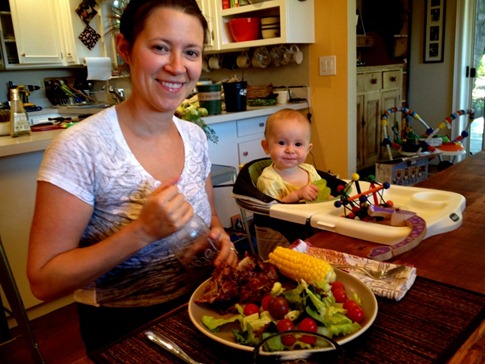
For something a little more substantial (sorry vegetarians, our bodies just don’t function as well without animal protein), last year we raised two Berkshire pigs. Since February, we’ve been happily pulling delicious and ethically satisfying cuts of meat out of our freezer. The societal opinion of pork seems to run the spectrum from “the other white meat” to bacon as an immediate precursor to life threatening chest pains. The primary, if not only, meat we consume, we’ve been enjoying it as more substantial and better texture than chicken with a lighter and more versatile taste than beef. It might have been interesting to have established a “Supersize Me” style benchmark for our cholesterol, blood pressure and other measurements of health before embarking on this diet, but the fact is, we feel healthy and good about the meat we’re consuming and plan to raise four Berkshires this year so a couple friends can stock their freezers as well. We personally don’t think pork is better or worse than any other lean, healthily-raised meat when consumed in moderation.

IMG_1403

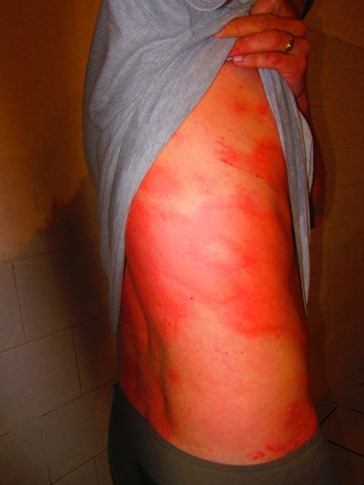
But what do we really care anyway? TEOTWAWKI is coming soon, right? Actually, according to the Mayan calendar, on December 21, 2012 to be exact. While none of the difficult-to-translate references to this date in stone carvings recovered from ruins seems to indicate exactly what the “end of days” will look like, my best guess is that it will resemble the day I was repeatedly bitten by fire ants while camping near the ancient Maya city of Palenque. In hindsight, it’s possible that King Yuknoom Yich’aak K’ahk’ was trying to warn me, although all I really got out of it was this sweet picture of full body hives and a really nervous wife checking my breathing all night.

Wait, it’s all starting to come together now! Just a few weeks after this pic, we went to Tikal, home the arch adversaries of the northern Maya king, and what happened? We forgot a water bottle underneath the steep stairs at Templo V, and when Ann went back for the bottle just as dusk was setting in, a group of Coatimundi ran across her path, scaring the hell out of her. Where were they all going? In hindsight, it seems clear they were all out looking for something to use to replace the severed head of Hunahpu, one of the Hero Twins, who - DO I HAVE TO SPELL THIS OUT FOR YOU PEOPLE?! – according to Mayan mythology, lost it when the gods of Xibalba (the underworld) cheated during a ceremonial ball game (it was “cut off by the giant killer bat, Camazotz, with his razor beak”). And ultimately, what did those coatimundi find that, when placed upon the neck of Hunahpu, assumed his facial features and allowed him to triumph in the game?


Wait for it…


IMG_3947

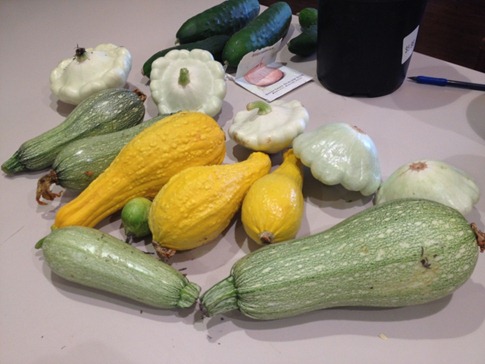
Yes, a squash. BOOM! And who do you know who has more effin’ squash than they know what to do with?

IMG_4366

Exactly, US! In retrospect, I fear we may have overlooked a timely opportunity to save the world. Ooops, our bad.

Well, whether we witness the end of time itself a few days before this Christmas (which may not sound so bad after couple hours of Christmas music at the mall), we’ve been wanting to be a little more prepared for the possibility of being “off the grid” for days at a time due to an earthquake, severe storm or “other.” We’re not necessarily worried about TEOTWAWKI, but it seems like a good idea to be somewhat prepared for a SHTF situation (read this, “SHTF vs TEOTWAWKI,” it’s funny).

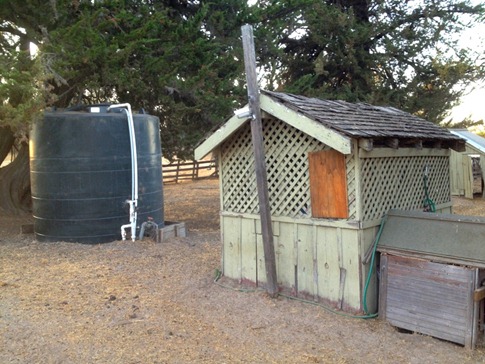
In addition to food which we’ve gotten a decent start on above, we’ve been looking into uninterruptible access to water, power and fuel and have found that they are all are related. For heat and cooking, we have access to plenty of firewood, propane BBQ’s and camping cooking stoves, but fuel is also needed to generate electricity. While we get our water from a well, an electric pump is required to draw the water up from 120 feet below our property and fill a 5000 gallon storage tank. Another electric pump fills an air tank to provide water pressure to the house. In the case of a power outage, water would still flow by gravity from the storage tank located slightly upslope from the house, or we could power the pressure tank pump with a small generator. Based on the assumption that the average person uses about 100 gallons of water a day on the upper end, the contents of the storage tank would last us a few weeks if we shut off irrigation to the landscaping and much longer if we conserved. While the well pump that refills the tank is only 1 horsepower (+/- 700 watts), this type of pump requires a much higher wattage to start – closer to 4000 watts – and would require a much larger generator to operate (not to mention 220V), so we’d be better of just relying on the stored capacity.

IMG_4573

Don’t worry, the automatic cat food feeder that drops Petunia’s food into the small doghouse at right runs on batteries so will not be affected by the apocalypse.

According to our online account with our power company, we typically use a range of 1-4 kW per hour in our daily lives. So that could be thought of as 10 to 40 100W lightbulbs. When you factor in computers (and wireless routers and cable modems), TV usage at night, the constant operation of the fridge and freezer, a pond pump, power tools and actual lightbulbs, it seems about right. It’s interesting to note when looking at usage by hour that our highest usage is in the morning and the late evening when our irrigation timers are set to run, thus triggering the well pump to replenish the storage tank. In “survival mode,” the real essentials would be the fridge and freezer with our supply of meat and preserved food. According to the manufacturers specifications, the fridge averages just under 2kW per day and the freezer around 1kW a day, each less than a 100W bulb. Add a few lights, maybe phone chargers and a radio to get information, and it seems that a 2000 watt generator would be enough to provide the power we would need. Small, portable, quiet units can be had from Honda in this power range for about $1200 and coincidentally, are the exact units many of the Airstream owners with trailers close to the size of ours recommend. An added benefit is that additional units can be wired in parallel to double the capacity, allowing either the flexibility of using one generator in one location and another elsewhere or using them together to run more power hungry devices in the house. 

To get power from the generator to the house, a transfer switch is required. This device is installed beside the main electrical panel and allows you to control which circuits are powered by the generator. It also prevents backflow of power from the generator to the electrical grid which can be dangerous. Note that we’ve also looked into solar power systems, both for day-to-day use as well as for emergencies, and found that the initial cost of the equipment plus the number of batteries that would be needed to store energy for when the sun wasn’t shining (night, weather or dust cloud from asteroid strike!) would be way too expensive. While the concept of every home or business having it’s own “power plant” on its roof sounds independent and romantic, my feeling for long term power for a community, central, consolidated power production would be more efficient and could be located in optimal areas as opposed to installation and maintenance of hundreds of thousands of disparate and less robust systems spread across multiple locations and environments. It reminds me a little of the movement of both business and personal Internet services from in-house servers and local storage to colocation facilities and cloud storage. While it’s not all “homesteady,” I just know from experience that sometimes it’s best to leave more complicated operations to professionals with experience and the ability to focus on one thing. But that’s not to say we wouldn’t want a backup.

So we’ve determined that without power, we can’t keep food fresh or get water pressure, and without fuel, we can’t provide power. At maximum capacity, the 2000W generator I mentioned above can run for 4 hours on a 1 gallon tank of gas. Estimates on the nut job survival enthusiast forums seem to suggest that running the freezer and fridge for 3-5 hours a day would be enough to keep them cold, but for the purpose of estimation, let’s assume the generator runs 8 hours a day. Running two units in parallel or possibly upgrading to a dedicated 4000W unit would double fuel consumption, so if we figured 4 gallons of gas a day, we’d be well covered. Of course, it completely depends on what exactly we’re “prepping” for, but if we were to allow – oh, I don’t know - two weeks for the reestablishment of civilization, we would want to have 54 gallons on hand. One 55 gallon steel barrel with a hand pump should do the trick, although figuring out how to fill it could be interesting. With this store of fuel, I suppose we’d have the option of staying put for those two weeks or spending a week evaluating and then filling the tank of one of the cars and hitting the road. 

IMG_3980

And speaking of hitting the road, I haven’t even mentioned our shiny silver escape capsule, the Airstream. As a backup to our backups, our little studio apartment on wheels actually has water, propane refrigeration and a few days of battery power that could be replenished either by a solar panel, a tow vehicle or portable generator. We could pretty much move out to the “back two” (the 4 acre version of “the back forty”) and be comfortable. Plus it’s usually pretty well stocked with whiskey from the last music festival we dragged it to!


The fact is, we don’t really live our daily lives thinking that something is going to happen to cut off our access to food, water, power and fuel. And we also haven’t committed ourselves to living off the grid or completely detached from the the food system. We love being connected to the Internet, going online to pay bills, checking the ChickenCam to see if everyone’s on their roosts just before sunset or downloading the latest episode of an addictive cable series.
IMG_2006

IMG_2001

But we also appreciate knowing that we could live without it, either by choice or necessity. And while we’re enjoying the satisfaction we’re getting from learning skills like food preservation and becoming more aware of our resource consumption, we’re also creating the kind of environment we’re excited to raise a kid in.

IMG_4156

IMG_4177