Monday, October 1, 2012

Hey that’s life on the farm: Gender Ambiguous Chicken

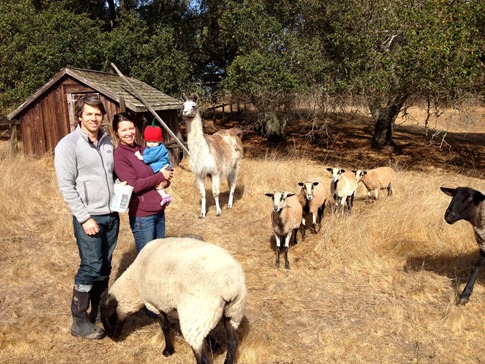
If you’ve been following along, you know that our farm has not historically offered chickens the longest lifespan. There was the malfunctioning automatic door incident where we learned that technical solutions are never 100% reliable and then the time someone left the egg door open where we learned that humans are not 100% reliable. Still, we’d prefer not to have to keep our girls locked up all day, albeit in their amply-sized coop and run. Letting them range during the day gives them access to grass and bugs that make their eggs that much better and while they’re pecking and scratching for treats, they’re spreading the sheep manure around the pasture and clearing away leaves piled at the bases of trees or along fencelines. Plus, they just look so happy and add an unquantifiable feeling of “farminess.” And in the worst case, at least the free-range, organic, pastured predator population will be well fed. But, hey, that’s life on the farm.
78190_10151071808042026_1293439429_o

Five months ago, we drove down to the feed store in town with a cardboard box in the backseat of the car to pick out some new chicks. We’d had nine chickens our first time around, and once they all started laying, would get close to three dozen eggs a week, far more than we could possibly use and close to the limit we could even pass off to friends. So this time, we’d decided to take a more sensible approach and pick up four new chicks to add to our current flock of two, a 2-week-old Ameraucana who our mother hen had hatched (the only survivor of the recent raid) and our seemingly unkillable Rhode Island Red who had thus far survived each of the bloodbaths. As we entered the back room filled with cages for the adolescents and warmers for the chicks, some dark black birds with caramel accents caught our eye. We settled on two of these Golden-Laced Wyandottes, about four weeks old, which would mean we’d get eggs from them in about 3-5 months. For the other two, we decided on some 2-week-old Hampshires (a breed developed from crossing the hardiness of Rhode Island Reds with the egg production of Leghorns) who would be the same age as our Ameraucana.

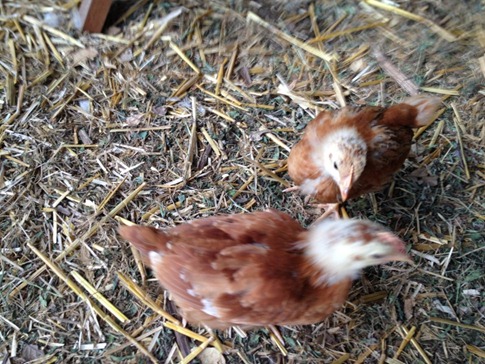
Whoever laid out the chick room had clearly gone to a retail marketing seminar and figured out to put the adorable little fluff balls right by the exit. Week old chicks are the Dentyne, Altoids and US Weekly of the poultry section. With two more peeping impulse buys (Delawares) playing “Jello” in the cardboard boxes in the backseat of the car, we headed home. Okay, so we now had eight chickens. Still better than nine, right?
IMG_2975

In the first few months, the chicks grew quickly, losing any remnants of the light, wispy feathers they were born with to longer, more defined new ones. At that point, they enter an awkward adolescence best compared to that reported by reflective supermodels on late night talk shows; They’re gawky, splotchy, uncoordinated and the older chicks pick on them. It’s not uncommon with pairs of animals of the same type or breed to have what they call a “poor doer.” We started to notice that one of the two Hampshires we’d picked up just didn’t seem to be “doing” as well as the other. We chalked it up to competition for food and figured she’d just catch up a little later.
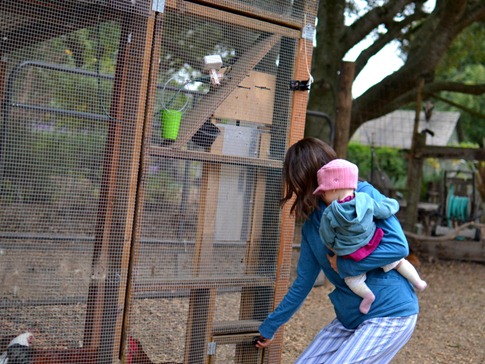
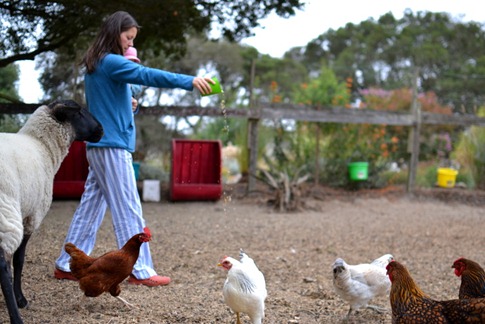
DSC_3007

DSC_3012

DSC_3022

Then one night, I found myself perusing the forums at Backyard Chickens and came across a section called “What breed or gender is this?” When we’d hatched out our chicks, I’d spent some time Googling how to determine the gender of day old chicks. While there were plenty of techniques discussed like dangling them from their feet or necks (the males are supposed to curl up to peck or scratch while the females give up), most amateurs were excited to report that they could get it right about half the time. I could get those numbers with “eenie meeny miny mo.” The experts at the hatcheries use more advanced techniques like inspecting feather growth or peering into the vents that contain the sexual and elimination organs. Still, the signs on the incubators at the feed store can only promise 90% accuracy. Lessee, if thus far we’d bought 10 chicks (4 the first time and 6 this time) from the feed store, that would mean that the odds are… hmmm… carry the 2… add the remainder… ? Damn, I’m so bad at math. Someone help me out here.

I started composing a post on the forum. Yes, one of our Hampshires was growing much faster than the other. Yes, the larger one had a more pronounced comb and waddle and yes, it had slightly more coloration in its tail feathers. But, as had been explained by the members of the forum in responses to other posts, all that could be explained by different speeds of maturation or slight variations in the breeding. The key, they all concluded, was in the behavior. Did the chicken in question behave like a rooster? I went outside to take some video.

I posted the thread anyway, but after having been charged by the bigger Hampshire every time I pointed the camera in its general direction while the others scattered, there was little doubt in my mind. A few weeks later, we heard the first attempted crow. Pretty sad really, like a teenager whose voice is changing, but he slowly became a man.

For some, that proud call would be a death sentence. Most neighborhoods don’t allow roosters, if they allow chickens at all. But we’re fully immersed in Ag country 5 miles outside of the city limits, not to mention Petaluma’s history as “The Egg Basket of the World.” Heck, our neighbors run an organic chicken farm. We’d happily keep him if only so I could ask everyone who visits if they want to see my co... [EDITED FOR CONTENT BY ANN].
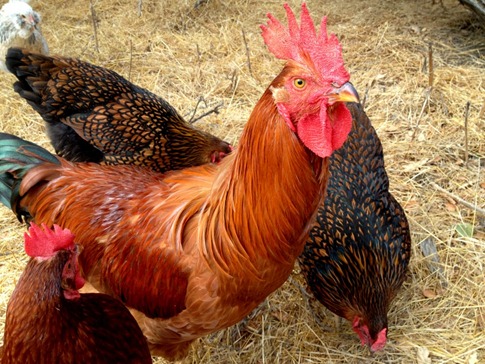
IMG_4632

But hey, that’s life on the farm.
Saturday, September 15, 2012

Hey, that’s life on the farm: The Greenhouse

When we go down to San Francisco or the East Bay to see friends for a BBQ or birthday party, the standard conversation starter is “So, what’s been going on?” They’ll respond with the typical news of job transitions, recently attended sporting events and perhaps the latest restaurant to pop up in the Mission (no doubt called “Mac” and proudly serving exclusively macaroni and cheese). “Hey, that’s life in the city,” we’ll say. We’ll reciprocate with stories of off-kilter outbuildings, mysterious water leaks, gender ambiguous chickens, sheep wrangling, pig enclosures and encounters with angry swarms of insects. To which they’ll respond, “Hey, that’s life on the farm.”

In an effort to post a little more frequently and for posts to have a bit more focus, I’m gonna do this one in parts. And with that, I now give you HTLOTF, Entry #1: The Greenhouse.

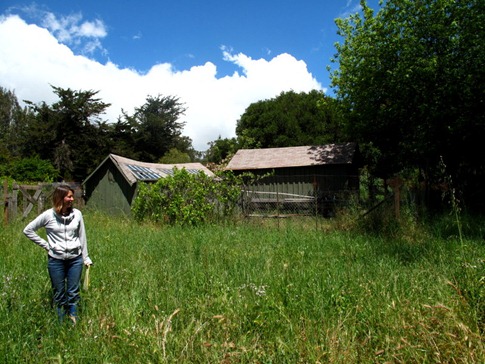
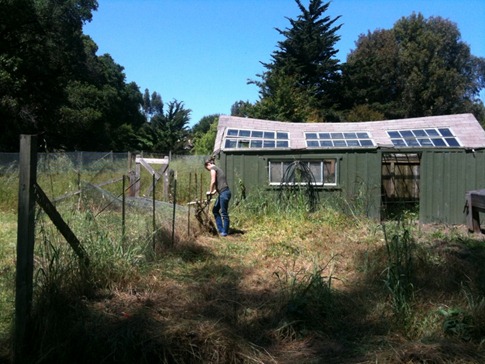
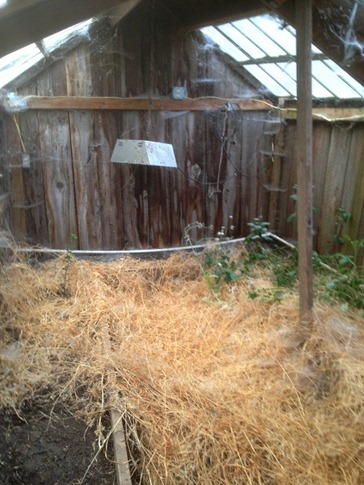
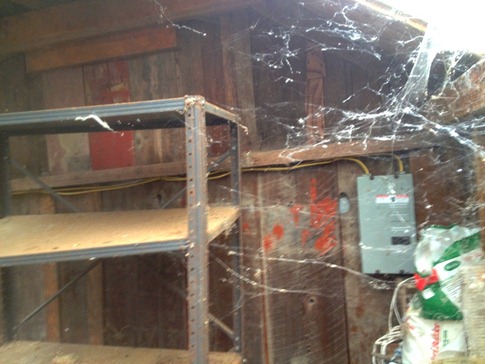
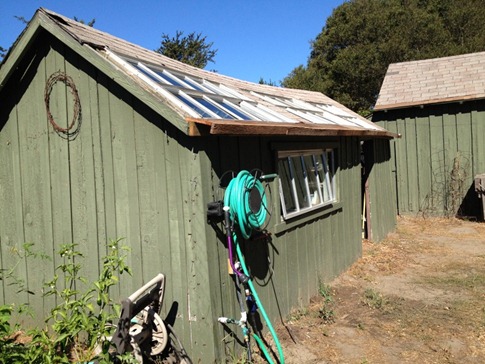
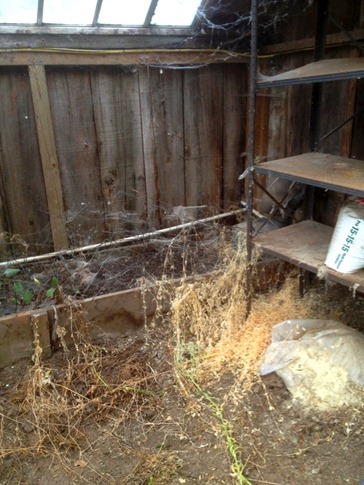
Of all the slanted shanties and spider web encrusted sheds we found on our property - not to mention a huge barn likely approaching 100 years of age - the only one the insurance agent had a problem with when we bought the place was the greenhouse. Sporting a saddle shape common among the older outbuildings of Petaluma, it’s possible that the ten light, operational overhead windows were about the only thing holding the roof up. Well, those and the thick fiber of webs spun by the countless Black Widow spiders, possibly a last ditch arachnoid retrofit attempting to save the place they’ve made their home.

IMG_3656

One of our first projects after moving in May of 2011 was to get a garden planted for the Summer. We quickly began tearing down the twisted fences that enclosed a 20 x 20 foot section of overgrown ground in front of the greenhouse and laid out a new perimeter for a 44 x 56 foot space. Over the next weeks, we set new posts, pulled new fencing, installed gates, routed irrigation and built raised planting beds from recycled mushroom boxes. Take a look back in the blog if you’re interested in more pics or stories.

IMG_0424-1

But we didn’t touch the greenhouse, only occasionally poking our heads in while showing friends around to point out the imposing shapes of venomous spiders and the egg sacks incubating hundreds of their creepy spawn hanging from the rafters.

IMG_4498 IMG_4496 IMG_4499

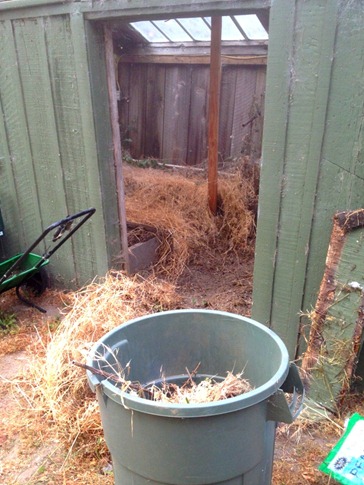
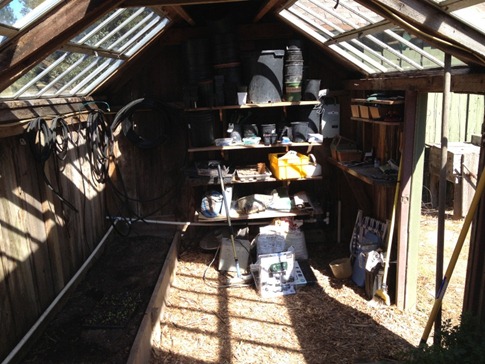
A couple weeks ago, I decided it was time. In a solid two hour push, I raked all the weeds out, blasted the spiders back to hell with the power washer and cleared everything out. Instantly, I started to see the potential

IMG_4495

IMG_4501 IMG_4500

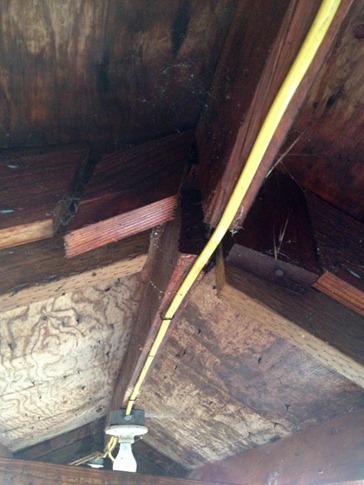
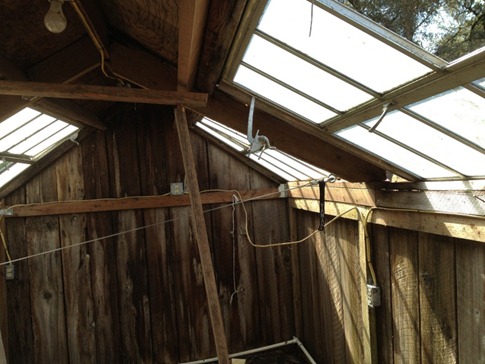
Oh, sorry, I didn’t finish that sentence. I started to see the potential of being crushed and diced to pieces when the roof collapsed in under the weight of the windows. Remember, it’s likely the Black Widow strands were the only thing holding it together, something perhaps our insurance agent had known. A close look at the interior of the roof showed signs of at least one attempted repair where some pressure treated 2x6’s had been sistered to the original rafters. Unfortunately, they were never properly attached to the ridge beam so as the weight of the roof flattened it and pushed the walls outward, the rafters were drawn away from the ridge.

IMG_4503

No problem. With an eye hook screwed into the west wall, I ran the winch cable from the ATV through the window from the opposite side (a barely visible cable coming from the left side of the picture below). As I winched the wall back to plumb, I used the tire jack from the “expedition vehicle” (which has been getting a lot of use lately!) and a 2x4 to lift the roof. With each small movement - a little winch, a little jack – I waited for a rain of glass from the torqued windows to come crashing down.

IMG_4523

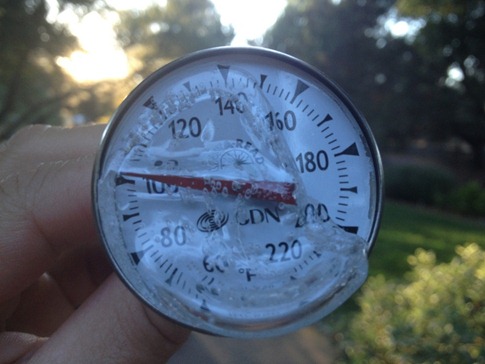
But it never came, and with everything held in place, I added a bracket to hold the wall vertical, added horizontal braces between the rafters to prevent them from sagging and secured the pressure treated reinforcement rafters to the ridge beam. When I loosened the winch cable and lowered the jack, there was a little drop, but everything settled into place nicely. Of course, I picked the two hottest days of the year to spend working inside the greenhouse.

IMG_4570

Oh, and on an unrelated note, apparently you can’t put this kind of meat thermometer into the oven.

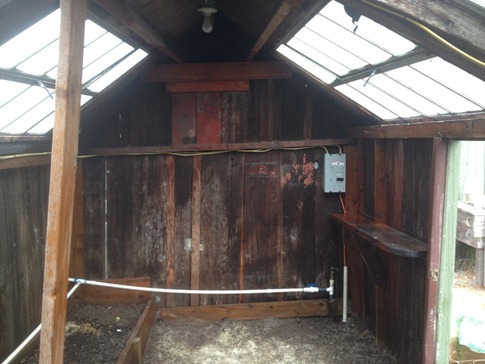
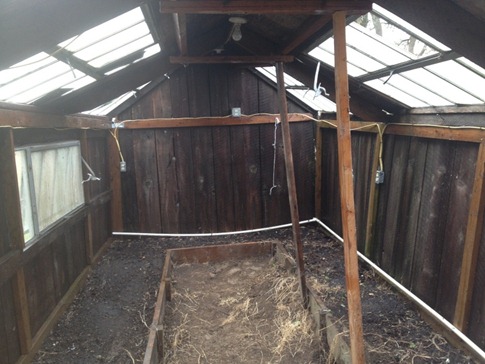
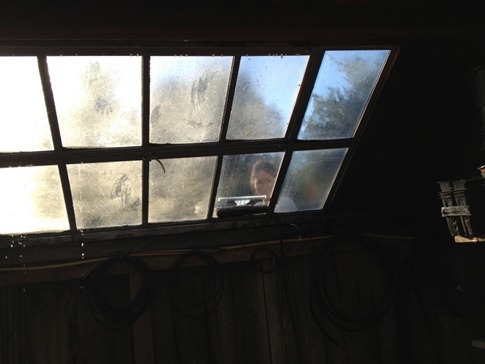
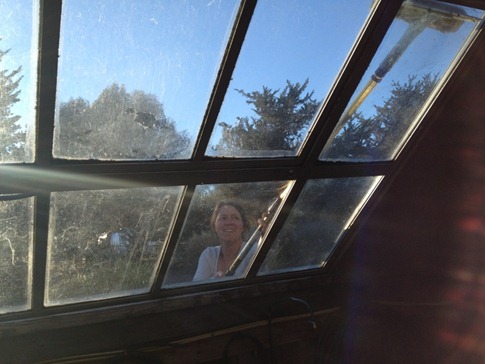
I asked Ann how many of the panes in the greenhouse windows she thought were broken. She guessed 5 or 7? It was actually only 2, we’d just been thinking the worst about this run down little building. But now, with a flat(ter) roof and a couple windows replaced, it was starting to look pretty good. A vigorous scrub and squeegee of the windows made a huge difference. 

IMG_4717

IMG_4723

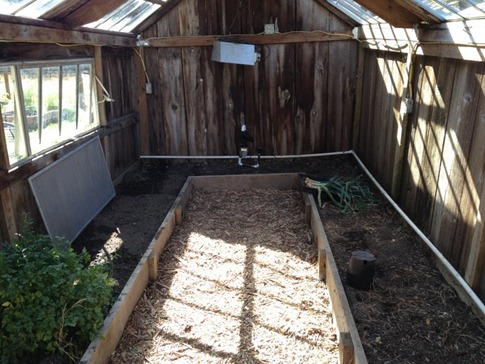
I tapped into the existing water line, installed an irrigation timer and spread mulch between the beds to keep the weeds down.

IMG_4741

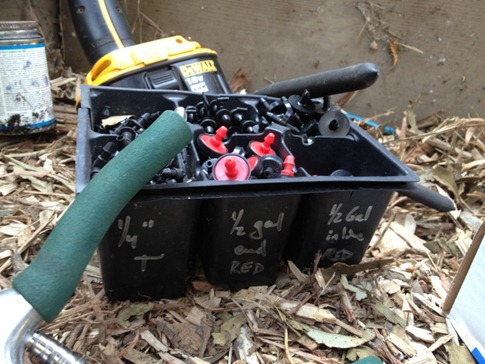
Next step was organizing all the doo dads and spray thingies that had been rattling around loose on our outdoor planting table. Stacks of orchard pots nested 6 feet high provided endless containers for sorting all the bits.

IMG_4740

IMG_4578

IMG_4739

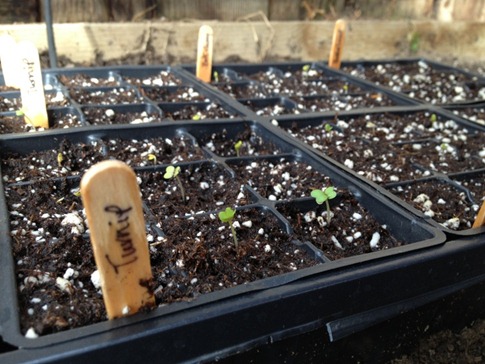
The only thing left to do was plant some seeds: kale and romaine for us and turnips we’re hoping the four pigs we’ll be getting in a couple weeks will like.

IMG_4657

We bought an old glass window which we’ll make into a door, but for now, I’d say we officially have a greenhouse. It may not be that exciting to everyone, but hey, that’s life on the farm!

IMG_4736

IMG_4735